

If you’ve lost a tooth, or you’re about to, you’ve probably landed on the same crossroads most of my Sun City patients do: the dental implants vs bridge decision. I’m Dr. Janne Lynch, and at our Sun City office on 103rd Avenue I have this conversation several times a week, usually with someone who has already heard three opinions from neighbors at the rec center and two more from their grandkids’ internet research. So let me walk you through it the way I would across the chair: what each option actually is, how they compare on the things seniors ask me about most, and how to figure out which one fits your mouth, your health, and your budget. There is no single right answer here, but there is usually a right answer for you.
And if nobody has said this to you yet: losing a tooth later in life is common, it is fixable, and it is nothing to be embarrassed about. You’re in good company, and you have good options.
First, What Are We Actually Comparing?
A dental implant is a small titanium post placed in the jawbone where your tooth’s root used to be. Over a few months, the bone fuses to it, and then we attach a custom crown on top. The result looks, feels, and chews like a natural tooth, because structurally it works like one: its own root, its own crown, standing independently.
A dental bridge replaces the missing tooth by anchoring to the neighbors. We reshape the two teeth on either side of the gap, crown them, and suspend a replacement tooth between them, one connected piece, cemented in place. No surgery, no healing months, and it has been a reliable workhorse of dentistry for generations.
Both beat leaving a gap. An untreated gap lets the neighboring teeth tilt, the opposing tooth drift down, and the bone underneath quietly shrink. So whichever way the dental implants vs bridge question goes for you, the worst option is usually “neither.
The Dental Implants vs Bridge Comparison, Point by Point
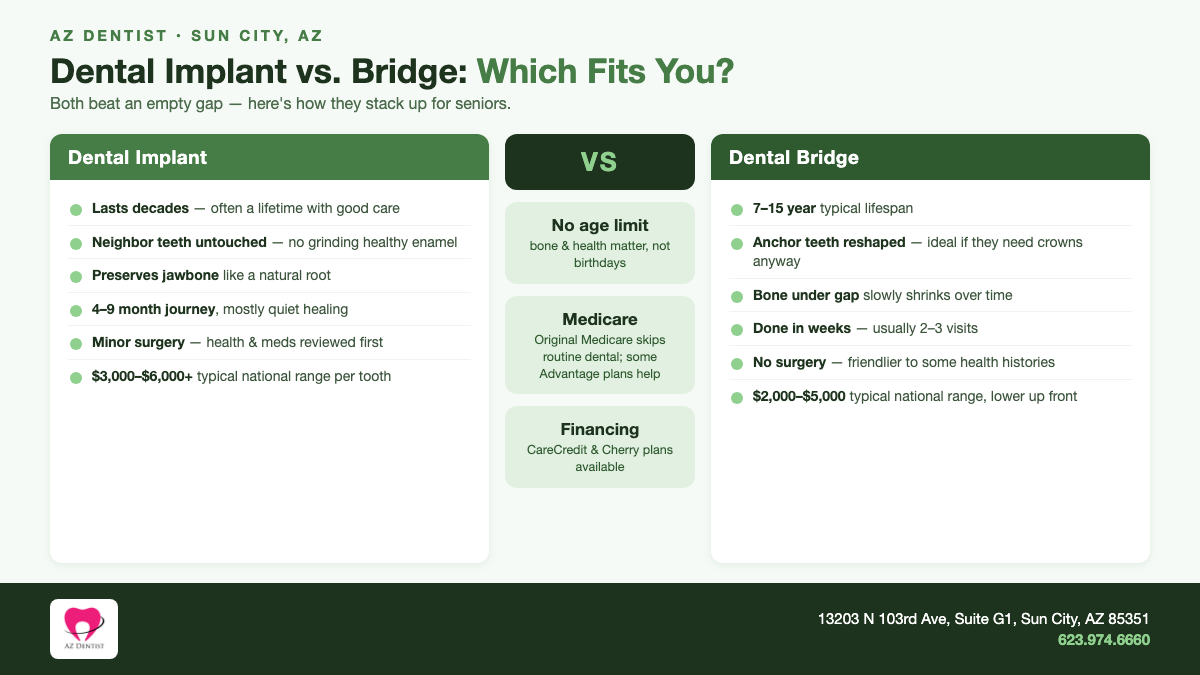
Longevity. This is the big one. A well-cared-for implant is designed to last decades, often the rest of your life, and the crown on top typically serves 10 to 15 years before it may need refreshing. Bridges generally last 7 to 15 years. For a 65-year-old in good health, that math can mean one implant visit now versus potentially replacing a bridge once or twice down the road.
Your neighboring teeth. Here’s the part of the dental implants vs bridge conversation I weigh most heavily. A bridge requires grinding down the two anchor teeth, even if they’re perfectly healthy. An implant leaves the neighbors completely alone. If those adjacent teeth already have large fillings or crowns, a bridge puts them to work and that can be fine. If they’re pristine, I’m reluctant to cut healthy enamel.
Your jawbone. An implant stimulates the bone the way a natural root does, which helps preserve it. Under a bridge, the bone in the gap keeps slowly shrinking, which is why an older bridge sometimes develops a visible space underneath. For seniors already managing bone density concerns, this difference matters more than most people expect.
Timeline. A bridge wins on speed: usually two to three visits over a few weeks. An implant is a journey, typically 4 to 9 months from consultation to final crown, and if the site needs a bone graft first, add healing time. Most of that is quiet waiting, not appointments, but it is a real difference.
Surgery and health factors. Implant placement is a minor surgical procedure, done fully numbed and usually easier than patients fear. But some conditions, certain medications (including some osteoporosis drugs), uncontrolled diabetes, and smoking can affect healing and success. A bridge involves no surgery at all, which can make it the safer call for some medical situations. This is exactly why the dental implants vs bridge decision starts with your health history, not a price list.
Daily care. An implant brushes and flosses like a normal tooth. A bridge needs a little extra technique, a floss threader or water flosser, to clean under the connected tooth, because a bridge that traps food can quietly cost you an anchor tooth to decay.
Weighing dental implants vs bridge? Bring us your questions — we’ll give you straight answers and real numbers.
AZ Dentist Sun City — 13203 N 103rd Ave, Suite G1, Sun City, AZ 85351
Call us directly: 623.974.6660
Let’s Talk Honestly About Cost
Nobody in Sun City has ever let me dodge this question, so I won’t. Nationally, a single implant with its connector and crown commonly runs in the $3,000 to $6,000+ range. A three-unit bridge is often somewhat less up front, frequently in the $2,000 to $5,000 neighborhood. Up front, the bridge usually wins.
Over twenty years, the picture often flips. If a bridge needs replacing once or twice, and especially if an anchor tooth is lost along the way and the next repair gets bigger, the “cheaper” option can quietly become the more expensive one. I’ve seen it go both ways, which is why I give patients both the today number and the realistic twenty-year picture before they choose a side in the dental implants vs bridge debate.
Two practical notes for my Medicare-age patients. Original Medicare generally doesn’t cover routine dental work, including implants and bridges, though some Medicare Advantage plans include dental benefits with annual maximums that can offset part of either option. And we offer financing through CareCredit and Cherry, because the right treatment shouldn’t hinge on one lump sum. Bring your plan details to your consultation and we’ll help you decode them; you’d be amazed how often the fine print surprises people in a good way.
Is There an Age Limit for Dental Implants?
This is the question behind the question for a lot of Sun City folks, so let me answer it plainly: no. There’s no upper age limit for implants. I’ve been part of implant journeys for patients well into their eighties, and the research consistently shows that success depends on bone quality, overall health, and aftercare, not the number on your birthday cake. The National Institute on Aging has a good overview of caring for your teeth and mouth as you age, and healthy teeth replacement is very much part of that picture.
What we do check carefully: bone volume (fixable with grafting in many cases), medications that affect bone or healing, conditions like diabetes and how well-controlled they are, and whether you smoke. For patients with metal sensitivities or who prefer a metal-free option, zirconia implants are also on the table. None of these automatically rules you out; they just shape the plan.
When I Lean Toward an Implant
- The neighboring teeth are healthy and unrestored, and grinding them down would sacrifice good enamel.
- You’re in reasonably good health and your bone is adequate, or graftable.
- You want the longest-lasting, lowest-maintenance result and don’t mind the months-long timeline.
- You’re already missing bone height and want to slow further loss.
- You’re replacing several teeth and want to avoid a long, vulnerable bridge span. For multiple missing teeth, implant-supported dentures can replace a whole arch on a handful of implants, a popular path for my denture-weary patients.
When a Bridge Makes More Sense
- The anchor teeth next door already need crowns anyway, so the bridge does double duty.
- Your health history or medications make surgery unwise.
- You want the gap closed in weeks, not months, perhaps ahead of a big family event.
- Bone loss at the site is severe and you’d rather not go through grafting.
- The up-front budget is firm, and a well-made bridge today beats a postponed implant indefinitely.
And a third door worth mentioning: a well-fitted removable partial. It’s the most budget-friendly route and surprisingly good these days. Our Sun City dentures and partials patients often use a partial as a comfortable interim step, or a permanent one. There’s no shame in any of these choices; there’s only the one that fits your life.
Not sure which way to go? Come in for a no-pressure consultation and leave with a written plan.
AZ Dentist Sun City — 13203 N 103rd Ave, Suite G1, Sun City, AZ 85351
Direct line: 623.974.6660 | Main line: (602) 638-2539
How We Help You Decide at Our Sun City Office
When you come in to settle your own dental implants vs bridge question, here’s what actually happens. We take 3D imaging so we can see your bone, not guess at it. We go through your health history and medication list together, and with your permission we’ll coordinate with your physician when something needs a second set of eyes. Then I lay out every reasonable option with honest pros, cons, and prices, including the do-nothing option and what it tends to cost later.
What I will never do is pressure you. I came to dentistry by way of social work, and I still believe my real job is helping people make decisions they feel good about, not selling the most expensive line on the menu. Some of my favorite outcomes at our Sun City dental implant practice started with a patient saying “convince me,” and ended with them choosing confidently, sometimes an implant, sometimes a bridge, sometimes a partial. Come as a patient, leave as a friend; it’s genuinely how we work.
Whichever you choose, protect the investment: brush twice daily, clean under or around the restoration as we show you, and keep up regular cleanings and exams so small problems stay small. The American Dental Association’s patient page on dental implants is a good plain-language companion read if you’d like homework before your visit.

Frequently Asked Questions
Which lasts longer in the dental implants vs bridge matchup?
Generally the implant. A well-maintained implant is designed to last decades, often for life, while bridges typically serve 7 to 15 years before needing replacement. That said, a beautifully cared-for bridge can outlast a neglected implant, so your home care and regular checkups matter as much as the hardware you pick.
Does getting a dental implant hurt more than getting a bridge?
Most patients are surprised on this one. Implant placement is done fully numbed, often takes under an hour, and the typical recovery is a few days of manageable soreness, frequently handled with over-the-counter pain relief. Bridge preparation is also numbed and painless, though the anchor teeth can be sensitive for a while afterward. Neither should be the deciding factor, and if dental anxiety is part of your hesitation, tell us; we treat nervous patients gently every day.
Will Medicare pay for my implant or bridge in Sun City?
Original Medicare generally does not cover routine dental work, including implants and bridges. Some Medicare Advantage plans include dental benefits, usually with an annual maximum that can offset part of the cost of either option. Bring your plan information to your consultation; our team reviews benefits with Sun City patients every week, and we offer CareCredit and Cherry financing to spread out the remainder.
How soon after losing a tooth do I need to decide?
Sooner is better than later, because bone begins shrinking within months of losing a tooth, and neighboring teeth start drifting. Waiting a year can mean needing a bone graft that wouldn’t have been necessary earlier. If you’ve already waited, don’t be embarrassed and don’t assume you’ve missed your window; grafting rebuilds many “too late” sites, and we’ll tell you honestly what’s still possible.
The Bottom Line for Sun City Smiles
If I had to compress the dental implants vs bridge decision into one paragraph: implants usually win on longevity, bone preservation, and protecting your other teeth; bridges win on speed, avoiding surgery, and up-front cost. Your health history, your bone, your neighboring teeth, and your budget are the tiebreakers, and that’s a conversation, not a search result. Come sit in my chair, bring your questions and your skepticism, and we’ll find the answer that fits you.
— Janne Lynch, DDS, practices at AZ Dentist’s Glendale, Scottsdale, Sedona, and Sun City offices. Connect with her on LinkedIn.
This article is educational and isn’t dental advice. Every mouth, health history, and insurance plan is different, so please contact us or your own provider for guidance about your specific situation before making treatment decisions.
Sun City, let’s close that gap — the right way for you.
AZ Dentist Sun City — 13203 N 103rd Ave, Suite G1, Sun City, AZ 85351
Call: 623.974.6660