
“My gums always bleed a little when I brush. Isn’t that normal?” I hear some version of that question almost every week, and my answer is always the same, gentle but honest: bleeding gums are common, but they aren’t normal. I’m Dr. Janne Lynch, and at our Glendale office on Bell Road, we see bleeding gums as an early message from your body that something needs attention. The good news is that when you catch it early, gum problems are often very manageable. In this guide, I’ll walk you through what bleeding gums can mean, how gum disease progresses, what periodontal treatment Glendale patients can expect from us, and how to keep your gums healthy once they’re back on track.
If you’re feeling a little embarrassed about your gums, please don’t be. I was once a nervous dental patient myself, and I promise you, there’s no lecture waiting for you in our chair. Just a plan.
Why Bleeding Gums Aren’t Normal
Healthy gums are usually pink, firm, and snug around your teeth. They shouldn’t bleed when you brush or floss gently. When they do, the most common reason is inflammation caused by plaque, the sticky film of bacteria that builds up along the gumline every day. If plaque isn’t removed, it can harden into tartar (also called calculus), which brushing and flossing at home can’t remove.
Your gums react to that bacterial buildup the way any part of your body reacts to irritation: they become red, puffy, tender, and quick to bleed. That early, inflamed stage is called gingivitis. It’s very common, and here’s the encouraging part: gingivitis is often reversible with a professional cleaning and better daily habits.
Other things can make gums more likely to bleed, too, including hormonal changes during pregnancy, certain medications such as blood thinners, smoking or vaping, diabetes, and brushing too hard with a stiff toothbrush. That’s one more reason to let us take a look rather than guessing on your own.
Warning Signs to Watch For at Home
Bleeding is often the first sign people notice, but it isn’t the only one. Call us if you notice any of the following:
- Gums that bleed when you brush, floss, or eat something crunchy
- Red, swollen, or tender gums
- Bad breath or a bad taste that doesn’t go away
- Gums that seem to be pulling back, making your teeth look longer
- Teeth that feel loose or seem to be shifting
- A change in the way your teeth fit together when you bite
- Pus between your teeth and gums, or a pimple-like bump on the gum
That last sign can point to an infection, sometimes a gum abscess or an abscessed tooth. If you have swelling in your face, fever, or throbbing pain, don’t wait for a routine visit. Our Glendale emergency dentist team keeps same-day time in the schedule for painful situations.
From Gingivitis to Periodontitis: How Gum Disease Progresses
Gum disease generally moves through stages, and the earlier we catch it, the simpler treatment tends to be.
Gingivitis. Inflammation is limited to the gums. There’s no permanent damage to the bone or the tissues that hold your teeth in place yet. A thorough cleaning and good home care can often bring things back to health.
Early to moderate periodontitis. If gingivitis isn’t treated, the inflammation can spread below the gumline. The gums start to pull away from the teeth, creating spaces called pockets. Bacteria collect in those pockets, and over time the bone and connective tissue supporting the teeth can begin to break down.
Advanced periodontitis. As more support is lost, teeth can loosen, shift, or eventually need to be removed. This is the stage we work hard to help patients avoid.
The National Institute of Dental and Craniofacial Research has a clear overview of gum disease if you’d like to read more about how it develops and who is most at risk.
Gums bleeding when you brush? Let’s take a look before it becomes a bigger problem.
AZ Dentist Glendale — 7200 W Bell Road, Suite C-3, Glendale, AZ 85308
Call us directly: 623.979.1900
What to Expect From Periodontal Treatment Glendale Patients Receive
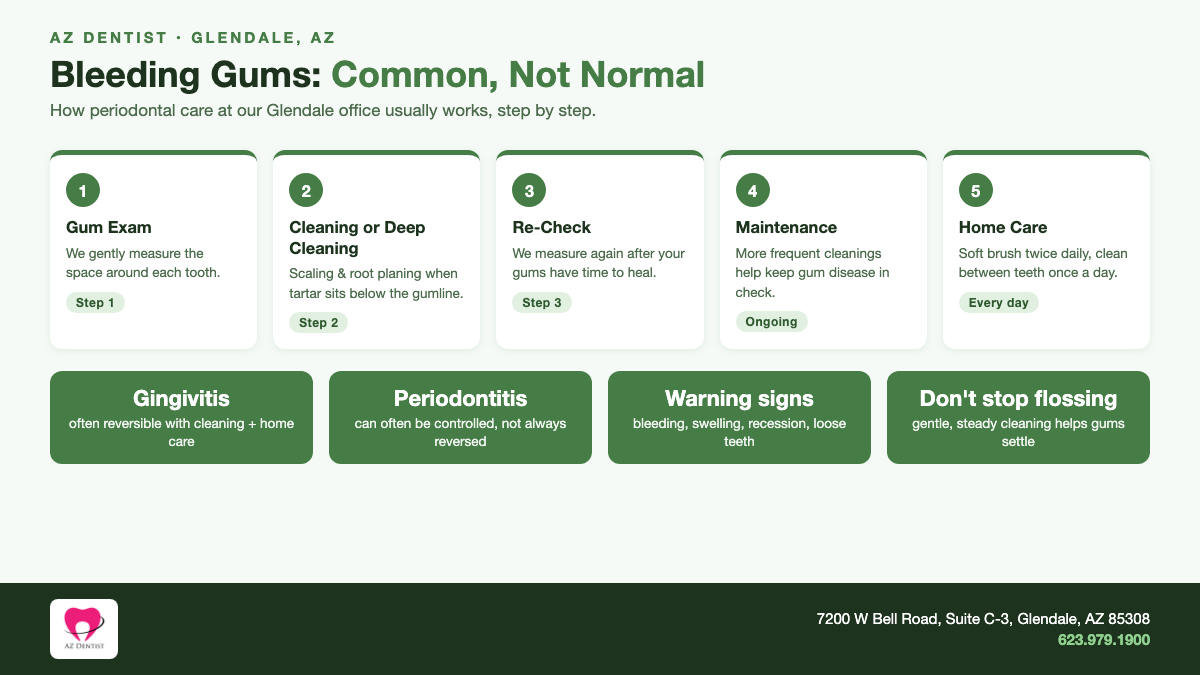
Every patient’s gums are different, so periodontal treatment Glendale patients receive at our office always starts with a careful look, not a one-size-fits-all plan. Here’s how a typical path works.
Step 1: A gum exam and measurements
We gently measure the space between each tooth and the gum around it using a small, thin instrument. Healthy gums usually have shallow spaces. Deeper pockets can be a sign that gum disease has moved below the gumline. We’ll also look for bleeding, recession, and any looseness, and we may take X-rays to check the bone that supports your teeth.
Step 2: A professional cleaning, or a deep cleaning
If your gums are inflamed but the deeper structures are healthy, a regular professional cleaning plus improved home care may be all you need. If there are deeper pockets and tartar below the gumline, we may recommend a deep cleaning, called scaling and root planing. Scaling removes plaque and tartar from above and below the gumline. Root planing smooths the root surfaces so the gums have a better chance to reattach and heal. We numb the area so you stay comfortable, and the work is often divided into sections of the mouth over more than one visit.
Step 3: A re-check
Gums need a little time to respond. A few weeks after a deep cleaning, we’ll measure again to see how well things have healed. Many patients see real improvement in bleeding and pocket depth when they keep up with home care.
Step 4: Ongoing periodontal maintenance
Once gum disease has been treated, it needs to be watched closely, because bacteria can recolonize those areas. Many patients who’ve completed periodontal treatment Glendale dentists recommend do best with more frequent cleanings than the typical twice a year. We’ll recommend a schedule based on how your gums respond.
When more advanced care is needed
Some cases need more than a deep cleaning, such as gum surgery or bone regeneration procedures. Depending on what your gums need, we’ll talk through the options and, when it’s appropriate, refer you to a periodontist, a dentist who specializes in the gums. Ask us which options our Glendale office offers in house; I’d always rather you understand the whole picture than be surprised later.
Why Periodontal Treatment Glendale Families Get Early Pays Off
As a mom of five, I’m a big believer in fixing small things before they turn into big ones, whether that’s a leaky faucet or a sore gum. Gum disease is often painless in its early stages, which is exactly why so many people put it off. But untreated periodontitis is a leading cause of tooth loss in adults.
When teeth do become too loose to save, the conversation shifts from saving teeth to replacing them. That can mean a surgical tooth extraction, and later, options like dental implants, which sometimes require a dental bone graft first if bone has been lost. Those are good, reliable treatments, but nearly every patient would rather keep their own teeth. Early periodontal treatment Glendale patients start today is how we try to make that possible.
Researchers have also studied associations between gum disease and other health conditions, such as diabetes and heart disease. Those links are still being studied, and having gum disease doesn’t mean you’ll develop another condition. But healthy gums are part of a healthy body, and it’s one more reason to take bleeding seriously. MedlinePlus has a helpful, plain-language page on gum disease as well.
Who Is at Higher Risk for Gum Disease?
Anyone can develop gum disease, but some people are more likely to, and they may benefit from more frequent checkups or earlier periodontal treatment. Glendale patients in any of these groups should mention it at their next visit:
- People who smoke or use tobacco, including vaping
- People with diabetes, especially when blood sugar is hard to control
- Women during pregnancy or other hormonal changes
- People taking medications that cause dry mouth or affect the gums
- Anyone with a family history of gum disease
- People with crowded teeth or older dental work that’s hard to clean around
- Adults who’ve gone a long time between cleanings
Here in the Valley, dry desert air and summer heat can leave some people mildly dehydrated, and a dry mouth gives bacteria an easier time. Keeping a water bottle handy is good for your whole body, gums included.
Healthy gums start with an honest exam. Glendale, we’ll go at your pace.
AZ Dentist Glendale — 7200 W Bell Road, Suite C-3, Glendale, AZ 85308
Direct line: 623.979.1900 | Main line: (602) 638-2539
Caring for Your Gums at Home After Treatment
The periodontal treatment Glendale patients receive in our chair matters, but what you do every day matters just as much. Here’s the routine I recommend to my own family:
- Brush twice a day for two minutes with a soft-bristled brush, angling the bristles toward the gumline. Gentle beats hard every time.
- Clean between your teeth once a day. Floss, small interdental brushes, or a water flosser can all work. The best tool is the one you’ll actually use.
- Don’t stop when you see a little bleeding. When people notice bleeding, they often back off flossing. Usually the opposite helps: gentle, consistent cleaning lets inflamed gums settle down over a week or two. If bleeding continues beyond that, call us.
- Keep your maintenance visits. They’re how we catch any return of gum disease early.
- Talk to us about tobacco. Quitting is one of the most helpful things you can do for your gums, and we’re happy to point you toward resources.
Many patients who commit to periodontal treatment Glendale offers and a steady home routine tell me their mouth feels fresher and their gums stop bleeding. Results vary from person to person, but consistency makes a real difference.

Frequently Asked Questions
Is a deep cleaning painful?
We numb the areas we’re working on, so most patients feel pressure and vibration rather than pain. Your gums may feel tender or a little sensitive for a few days afterward. If you’re anxious, tell us; we’ll take breaks and go at your pace.
How much does periodontal treatment in Glendale cost?
Costs depend on how many areas need care and what type of treatment is right for you. Many dental insurance plans cover part of periodontal treatment when it’s needed. We’ll give you a clear estimate before anything begins and help you check your benefits. We also offer CareCredit and Cherry financing.
Can gum disease be cured?
Gingivitis is often reversible with professional cleaning and good home care. Periodontitis can’t always be fully reversed, because lost bone doesn’t usually grow back on its own, but it can often be controlled with treatment and regular maintenance so it doesn’t keep progressing.
How do I know if I need periodontal treatment in Glendale?
Persistent bleeding, gum recession, bad breath that won’t go away, or teeth that feel loose are all good reasons to schedule an exam. The only way to know for sure is a gum evaluation, which we can do at a routine visit at our Glendale office.
Your Next Step for Healthier Gums
If your gums bleed when you brush, don’t ignore it and don’t panic. It’s simply a sign worth checking. Periodontal treatment Glendale patients receive at our Bell Road office starts with a gentle exam, honest answers, and a plan that fits your mouth and your life. Come as a patient, leave as a friend, and leave with gums that feel a whole lot better.
— Janne Lynch, DDS, practices at AZ Dentist’s Glendale, Scottsdale, Sedona, and Sun City offices. Connect with her on LinkedIn.
This article is educational and isn’t dental or medical advice. Bleeding gums can have many causes, and treatment needs and results vary. Please contact us or your own provider for guidance about your specific situation.
Glendale, bleeding gums are worth a call. Let’s get them healthy again.
AZ Dentist Glendale — 7200 W Bell Road, Suite C-3, Glendale, AZ 85308
Call: 623.979.1900