
When a tooth is badly infected or damaged, you usually end up at the same fork in the road: save it with a root canal, or take it out. I’m Dr. Janne Lynch, and at our Sedona office on State Route 89A, I walk patients through this decision often, sometimes with a retiree who has been nursing a sore molar for weeks, sometimes with a visitor who bit down wrong on vacation. If you’re weighing a root canal Sedona patients can trust against a simple extraction, this guide explains how I actually decide which option saves more: more of your natural smile, more of your budget over time, and more of your comfort. There’s no one-size answer, but there is a clear way to think it through.
And a quick reassurance before we begin: root canals have a reputation they no longer deserve. With modern numbing and techniques, many patients tell me the procedure felt a lot like getting a filling. The pain people remember usually came from the infection, not the treatment.
What Each Option Actually Involves
A root canal treats the inside of the tooth. Deep inside every tooth is the pulp, a soft core of nerves and blood vessels. When a deep cavity, a crack, or trauma lets bacteria reach that pulp, it can become inflamed or infected, sometimes forming an abscessed tooth. During a root canal, we numb the area, gently clean out the infected pulp, disinfect and shape the canals, and seal them. Most back teeth then need a crown to protect them, because a treated tooth can become more brittle over time.
An extraction removes the whole tooth. Some extractions are simple, while others, especially broken teeth or molars with curved roots, need a surgical tooth extraction. Afterward, the socket heals over a few weeks. Then comes the part people often forget to plan for: deciding whether and how to replace the missing tooth.
The American Dental Association’s MouthHealthy site has a clear, patient-friendly overview of root canals if you’d like to read more before your visit.
Root Canal Sedona vs. Extraction: A Side-by-Side Comparison
Here’s how the two options compare on the things my Sedona patients ask about most.
Keeping your natural tooth. A root canal preserves your own tooth, including its root, which keeps stimulating the jawbone and holds its place in your bite. An extraction removes it permanently. In my experience, there’s no replacement that feels quite as natural as your own tooth, which is why I lean toward saving teeth when the odds are good.
Up-front cost. An extraction is usually less expensive on the day of treatment. A root canal plus a crown typically costs more at first.
Long-term cost. This is where the math often flips. If an extracted tooth needs to be replaced, a dental implant or bridge can cost more than the root canal and crown would have. And if the site needs a bone graft first, that adds time and expense. So “cheaper today” isn’t always “cheaper overall.”
Time and visits. A root canal is often completed in one or two visits, followed by a crown. An extraction is typically a single visit, but a replacement implant can take several months from start to finish.
Recovery. After a root canal, most patients have a few days of tenderness that’s usually managed well with over-the-counter pain relief. After an extraction, healing involves a blood clot forming in the socket, soft foods for a few days, and avoiding straws and smoking to protect that clot.
What happens to your bite. If a back tooth is removed and not replaced, the neighboring teeth can drift into the gap and the opposing tooth can shift, which can change how you chew over time. This is one of the most overlooked costs of extraction.
Throbbing tooth? Let’s find out if it can be saved, today if possible.
AZ Dentist Sedona — 1146 W State Route 89A, Suite C1, Sedona, AZ 86336
Call us directly: 928.282.3266
How Our Sedona Dentist Decides: The 5 Questions I Ask
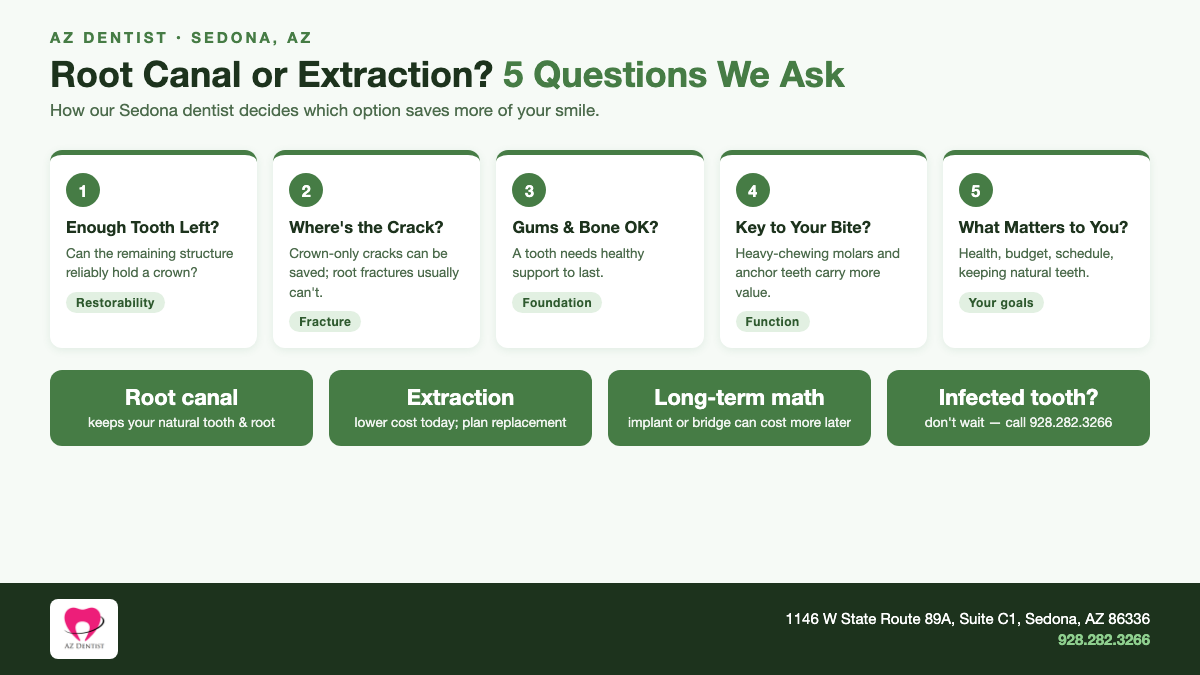
When I’m deciding whether to recommend a root canal Sedona patients can count on, or whether extraction is the wiser call, I’m really answering five questions. I’ll share them so you can follow my thinking.
1. Is there enough healthy tooth left to restore?
A root canal fixes the inside of the tooth, but the outside has to be strong enough to hold a crown. If decay or a fracture has destroyed too much of the tooth, especially below the gumline, even a perfect root canal may not leave us anything solid to build on. In that case, extraction may be the more honest recommendation.
2. Where is the crack, and how deep does it go?
Some cracks stay in the crown of the tooth and can be managed with a root canal and a crown. Others split down into the root. A tooth with a vertical root fracture generally can’t be saved, and recommending a root canal on it would only delay the inevitable. If you’ve recently chipped or cracked a tooth, X-rays and a careful exam help us tell the difference.
3. How healthy are the gums and bone around it?
A tooth needs good support to last. If advanced gum disease has destroyed much of the bone around it, the tooth may be loose, and saving the inside of the tooth won’t fix the foundation. In that situation, extraction and a plan for replacement may serve you better.
4. How important is this tooth to your bite?
A molar that does heavy chewing work, or a tooth that anchors existing dental work, carries more value than, say, a wisdom tooth with no opposing partner. I weigh how much that particular tooth matters to your function and comfort.
5. What matters most to you?
This one isn’t clinical, but it’s just as important. Your health history, your budget, your schedule, and how you feel about keeping natural teeth all belong in the decision. Some of my Sedona patients are seasonal residents who need treatment to fit before they travel. Others are determined to keep every natural tooth they can. My job is to lay out honest options, not to pick for you.
When a Root Canal Usually Makes More Sense
In general, a root canal Sedona patients receive is often the better choice when:
- The tooth has enough healthy structure left to support a crown
- The gums and bone around it are in good shape
- Any crack is limited to the crown, not the root
- The tooth plays an important role in chewing or in holding other dental work
- You’d prefer to keep your natural tooth and avoid the cost and time of replacing it
Many people who come in for a root canal Sedona consultation are surprised to learn how often a tooth they assumed was “too far gone” can actually be saved. Infection on its own doesn’t automatically mean extraction; in fact, treating that infection is exactly what a root canal is for.
When Extraction Is the Wiser Choice
On the other hand, extraction often makes more sense when:
- The tooth is cracked or split down into the root
- Too little tooth structure remains to restore it reliably
- Advanced gum disease has left the tooth loose with little bone support
- It’s a wisdom tooth or a tooth with no functional role in your bite
- A previous root canal has failed and retreatment isn’t a good option
If we do recommend extraction, we’ll talk through replacement options before we ever pick up an instrument, so you’re never left wondering “what now?” with a gap in your smile.
What a Root Canal Sedona Visit Feels Like at Our Office
Fear of the unknown makes everything worse, so here’s what to expect. We start by numbing the area thoroughly and checking that you’re comfortable before we begin. A small protective sheet called a dental dam isolates the tooth and keeps everything clean. Then we gently remove the infected tissue, clean and shape the canals, and seal them. Depending on the tooth, a root canal Sedona patients receive at our office may be completed in one visit or two, followed by a crown to protect it.
I was a nervous dental patient myself for years, so I never rush. If you need a break, raise your hand and we pause. If you’re anxious, tell us when you call. We’ll go at your pace, and we’ll explain each step as we go. Come as a patient, leave as a friend; it really is how we try to work.
Root canal or extraction? Get a straight answer from our Sedona team.
AZ Dentist Sedona — 1146 W State Route 89A, Suite C1, Sedona, AZ 86336
Direct line: 928.282.3266 | Main line: (602) 638-2539
Frequently Asked Questions
Is a root canal more painful than an extraction?
Both procedures are done with the area fully numbed, so most patients feel pressure rather than pain during treatment. Afterward, a root canal typically brings a few days of tenderness, while an extraction site needs a bit more care as the socket heals. Many patients find the root canal recovery easier than they expected, and both are far more comfortable than living with an infected tooth.
What does a root canal Sedona patients receive cost compared to an extraction?
An extraction usually costs less on the day of treatment. A root canal plus a crown typically costs more up front, but if an extracted tooth later needs an implant or bridge, the total can end up higher than saving the tooth would have been. Every case is different, so we’ll give you clear pricing for both options before you decide. Insurance often covers part of either, and we offer CareCredit and Cherry financing.
Can I wait to decide?
If a tooth is infected, waiting is risky. Infections can spread, swelling can worsen, and a tooth that’s saveable today may not be in a few weeks. If you have facial swelling, fever, or trouble swallowing or breathing, seek emergency care right away. Otherwise, call us so we can at least evaluate the tooth and get any infection under control while you weigh your options.
I’m visiting Sedona. Can you help me before I go home?
Yes, we see visitors and seasonal residents regularly. Depending on the situation and our schedule, we may be able to complete treatment or stabilize the tooth so you can travel comfortably and follow up with your home dentist. Call our Sedona office directly at 928.282.3266 and let us know your travel dates.
The Bottom Line for Sedona Smiles
When a tooth can be predictably saved, a root canal usually saves more: more of your natural smile, more bone, and often more money over the long run. When it can’t, a well-planned extraction followed by thoughtful replacement is the healthier path. The key is an honest evaluation, and that’s exactly what you’ll get at a root canal Sedona consultation in our office. Bring your questions, and we’ll find the answer that fits you.
— Janne Lynch, DDS, practices at AZ Dentist’s Glendale, Scottsdale, Sedona, and Sun City offices. Connect with her on LinkedIn.
This article is educational and isn’t dental advice. Every tooth, health history, and situation is different, so please contact us or your own provider for guidance about your specific situation before making treatment decisions.
Sedona, let’s save what can be saved.
AZ Dentist Sedona — 1146 W State Route 89A, Suite C1, Sedona, AZ 86336
Call: 928.282.3266