
“So what actually happens, start to finish?” It’s the first question almost every patient asks me about dental implants Scottsdale offices offer, and it’s a great one. I’m Dr. Janne Lynch, and at our Scottsdale office on Via Linda, I’d rather you walk into your consultation knowing the whole road map than feel surprised at any step. An implant isn’t a single appointment; it’s a short journey, usually a few months from first conversation to final crown, with most of that time spent quietly healing. Below, I’ll walk you through each stage the way I explain it chairside: what we do, how long it typically takes, how it tends to feel, and what you can do to help it go smoothly.
If you’re nervous, I get it. I was a fearful dental patient for years before I became a dentist. Knowing exactly what’s coming is one of the best ways I know to take the fear out of it.
Why Patients Choose Dental Implants in Scottsdale
A dental implant replaces a missing tooth from the root up. A small post, usually titanium, is placed in the jawbone. Over time, the bone fuses to it, creating a sturdy foundation. Then we attach a custom crown that’s designed to match your natural teeth. The result looks, feels, and functions much like a natural tooth.
Patients considering dental implants Scottsdale offices provide often tell me they want something that doesn’t move, doesn’t need to come out at night, and doesn’t require reshaping the healthy teeth next door, which a traditional bridge does. Implants also help preserve the jawbone, because the post stimulates the bone much like a natural root. For many people, it’s the closest thing to getting their own tooth back.
For a plain-language overview from the American Dental Association, the MouthHealthy page on dental implants is a good companion read.
The Dental Implants Scottsdale Process, Step by Step
Every mouth is different, and your timeline may be shorter or longer depending on your bone, your health, and whether a tooth needs to come out first. But here is the typical path from consult to crown.
Step 1: The consultation and 3D planning
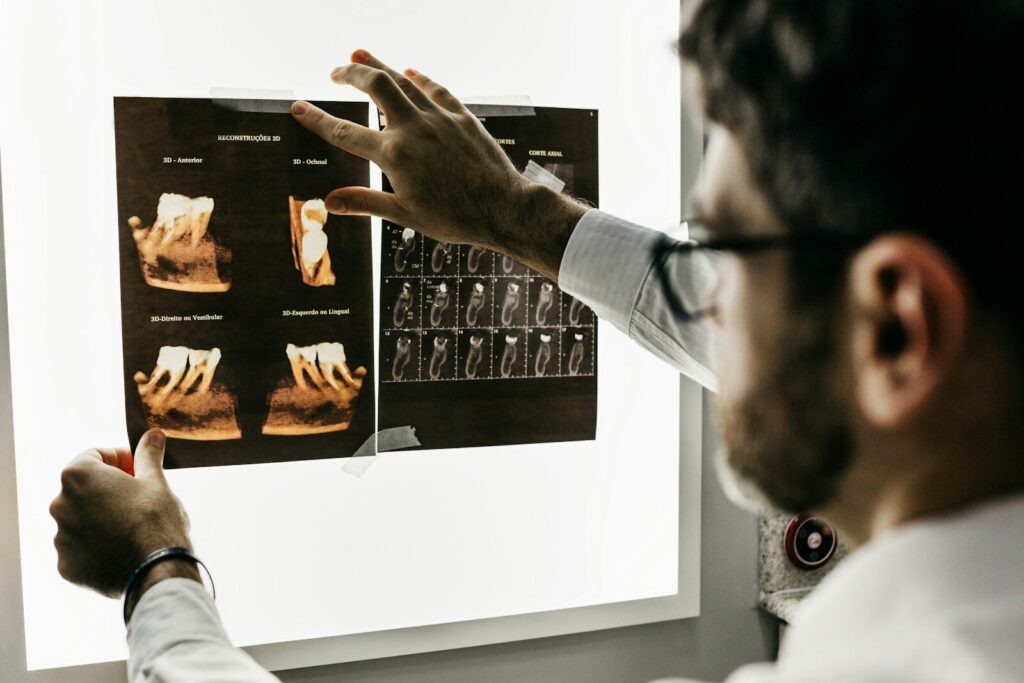
We start with a conversation. What are you hoping for? Which tooth or teeth are we talking about? What’s your health history, including medications, diabetes, smoking, and any bone-density treatment? Then we examine your mouth and take imaging, often including 3D scans, so we can see the height, width, and quality of your bone and the location of nerves and sinuses. From there, I’ll lay out your options, an estimated timeline, and clear pricing. No pressure, and you’re welcome to go home and think about it.
Then we draft the plan. For many of the dental implants Scottsdale patients receive at our office, I’ll show you exactly where the implant will sit on your scan, explain why, and point out anything that could change the timeline. To make the most of this visit, bring a list of your medications and supplements, any recent X-rays from another office, your insurance information, and every question you’ve been saving up. There is no such thing as a silly question here; the more you ask, the more comfortable you’ll feel at each step that follows.
Step 2: Extraction, if a tooth still needs to come out
If the tooth is still there but can’t be saved, the first procedure is removing it. Sometimes that’s a simple extraction; other times, it’s a surgical tooth extraction. In some cases, an implant can be placed at the same visit. In others, we let the site heal first. I’ll explain which approach fits your situation and why.
Step 3: Bone grafting, if needed
Implants need enough healthy bone to hold them securely. After a tooth is lost, the bone in that area can shrink over time. If the imaging shows we need more support, a dental bone graft helps rebuild the area. Grafting can sometimes be done at the time of extraction or implant placement; other times, it needs a few months of healing on its own. Not everyone needs it, but it’s a common and well-established part of implant dentistry.
Step 4: Placing the implant
This is the step most people worry about, and it’s usually easier than they expect. The area is fully numbed, and sedation options can be discussed for anxious patients. We place the implant post into the bone, often in under an hour for a single tooth. Afterward, most patients have a few days of soreness and mild swelling, which is often managed with over-the-counter pain relief, ice, and soft foods.
Step 5: Healing and osseointegration
Here’s the quiet part. Over the next few months, your jawbone fuses with the implant in a process called osseointegration. It’s what makes an implant so stable. During this time, you go about your normal life. If the implant is in a visible area, we can discuss temporary options so you’re never without a smile.
Step 6: The abutment and your final crown
Once the implant has integrated, we attach a small connector called an abutment, then take impressions or digital scans to design your crown. The crown is shaped and shaded to blend with your natural teeth. When it’s ready, we attach it, check your bite carefully, and make any fine adjustments. That’s the finish line: a complete, functional tooth.
Curious if implants are right for you? Start with a no-pressure consultation.
AZ Dentist Scottsdale — 10245 E Via Linda, Suite 226, Scottsdale, AZ 85258
Call us directly: 480.860.6550
Dental Implants Scottsdale Timeline: How Long Does It Take?
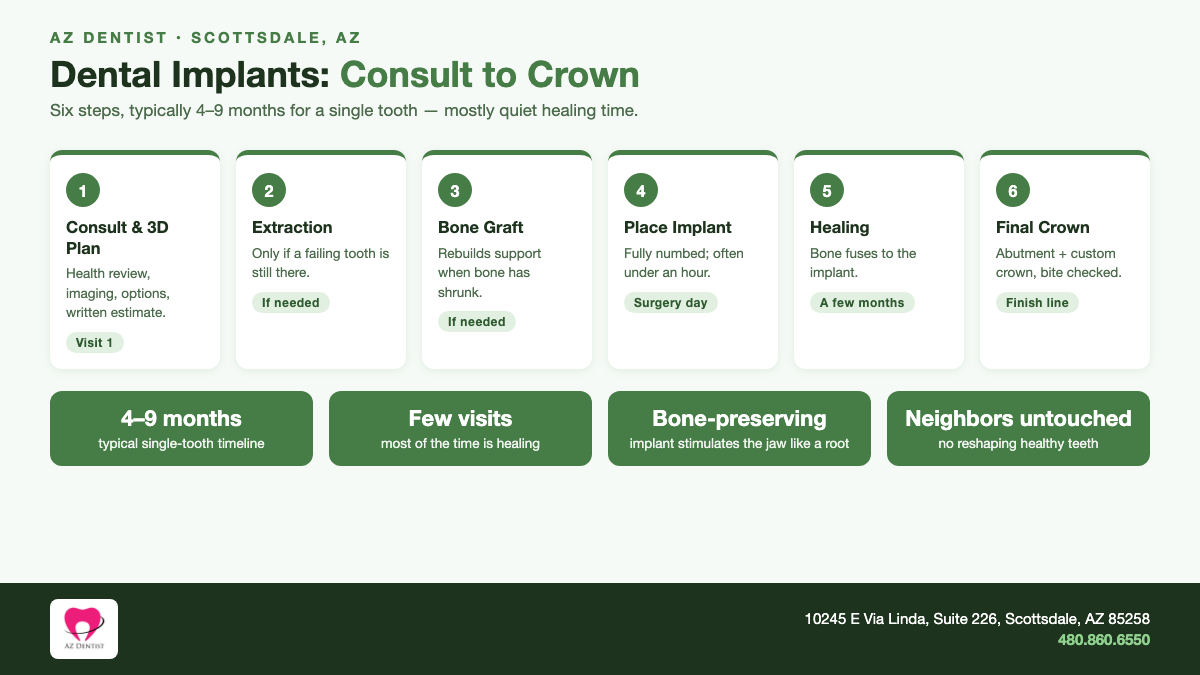
For a single tooth, the full process commonly takes about 4 to 9 months from consultation to final crown. The biggest variables are:
- Whether a tooth needs to be extracted first, and whether the implant can be placed at the same visit
- Whether bone grafting is needed, and how much healing the graft needs
- How quickly your bone integrates with the implant, which varies from person to person
- Your overall health, including conditions like diabetes or smoking, which can slow healing
The good news: most of that time is healing, not appointments. Many patients are surprised by how few actual visits the process involves. When people ask me about dental implants Scottsdale timelines, I always remind them that patience during healing is what gives the implant its long-term strength.
Choosing the Right Implant Option for You
Not every implant plan looks the same. Depending on your needs and preferences, we may talk about:
Single-tooth implants. One post, one crown, replacing one missing tooth. This is the most common scenario I see.
Metal-free options. Some patients prefer a metal-free alternative. Zirconia implants are a ceramic option that may suit people with metal sensitivities or particular aesthetic goals. We’ll discuss whether they’re a good fit for your situation.
Implant-supported dentures. If you’re missing many or all of your teeth, a few strategically placed implants can anchor a full set of teeth. Implant-supported dentures are far more stable than traditional dentures, and many patients find chewing and speaking much more comfortable with them.
Implant crowns and other restorations. The crown on top of your implant is just as important as the post underneath. Our team also places traditional dental crowns in Scottsdale, so we pay close attention to shape, shade, and bite on every restoration.
What Affects the Cost of Dental Implants in Scottsdale
I believe in straight answers about cost, so here’s what shapes the price of dental implants Scottsdale patients receive. The total depends on how many teeth are being replaced, whether you need an extraction or bone graft, the type of implant and crown material, and whether sedation is part of the plan. That’s why I give every patient a written estimate after the consultation, before any treatment begins.
Some dental insurance plans cover part of the process, often the crown or extraction portion, and many patients use FSA or HSA funds. We also offer CareCredit and Cherry financing to help spread out the cost over time. And because implants are designed to last for many years with good care, many patients find the long-term value compares well with options that may need replacing sooner.
Get a clear implant plan, timeline, and written estimate.
AZ Dentist Scottsdale — 10245 E Via Linda, Suite 226, Scottsdale, AZ 85258
Direct line: 480.860.6550 | Main line: (602) 638-2539
Caring for Your Implant So It Lasts
An implant can’t get a cavity, but the gums and bone around it still need care. Brush twice a day, clean between your teeth daily with floss, interdental brushes, or a water flosser, and keep up with regular cleanings and exams so we can check the implant and the tissue around it. If you smoke, cutting back or quitting can help protect your investment. And if you grind your teeth at night, ask us whether a night guard makes sense.
Most of the dental implants Scottsdale residents have placed at our office are checked at their regular cleanings, where we look at the gums around the implant, confirm the bite still feels right, and catch small issues early. Between visits, call us if you notice bleeding around the implant, a loose-feeling crown, or a change in how your teeth come together.
I tell every implant patient the same thing: the hardware is only as good as the habits around it. Take care of it, and it can serve you well for many years.
Frequently Asked Questions
Does getting a dental implant hurt?
The procedure itself is done with the area fully numbed, so most patients feel pressure rather than pain. Afterward, a few days of soreness and mild swelling are common and are often managed with over-the-counter pain relief. Many patients tell me it was easier than having the original tooth removed. If anxiety is a concern, ask us about sedation options.
Am I too old for dental implants?
There’s generally no upper age limit. What matters more is your overall health, your bone, and your ability to heal. I’ve seen patients in their seventies and eighties do very well with implants. We’ll review your health history carefully and coordinate with your physician when needed.
Can I get my implant and crown in one day?
In select cases, a temporary crown can be placed on the same day as the implant, but the final crown usually waits until the implant has fully integrated with the bone. That healing time is what gives the implant its strength. We’ll let you know whether same-day temporary options fit your situation.
How do I know if I’m a candidate for dental implants in Scottsdale?
Most adults with good general health and enough bone, or bone that can be rebuilt with grafting, are candidates. Uncontrolled diabetes, heavy smoking, certain medications, and some medical conditions can affect healing. The best way to know is a consultation with 3D imaging, which lets us give you a clear, honest answer.
Your Next Step Toward a Complete Smile
The road from consult to crown can feel long when you first hear it, but it’s a well-traveled path, and you won’t walk it alone. If you’ve been wondering about dental implants Scottsdale patients trust, call our office, ask for a consultation, and bring all your questions. Come as a patient, leave as a friend, and hopefully with a plan you feel genuinely good about.
— Janne Lynch, DDS, practices at AZ Dentist’s Glendale, Scottsdale, Sedona, and Sun City offices. Connect with her on LinkedIn.
This article is educational and isn’t dental advice. Timelines, costs, and results vary from patient to patient, so please contact us or your own provider for guidance about your specific situation before making treatment decisions.
Scottsdale, your complete smile starts with one conversation.
AZ Dentist Scottsdale — 10245 E Via Linda, Suite 226, Scottsdale, AZ 85258
Call: 480.860.6550