

“My cardiologist asked about my gums. Why would a heart doctor care about my gums?” I hear some version of that question regularly at our Sun City office on 103rd Avenue, and it’s a smart one. I’m Dr. Janne Lynch, and in this article I want to explain the gum disease heart health connection in plain language: what the research suggests, what it doesn’t prove, why it matters more after 60, and what Sun City patients can do about it. The short version is that your mouth isn’t separate from the rest of your body. Keeping your gums healthy is one of the simplest, most practical things you can do for your overall health, at any age.
And if your gums bleed when you brush and you’ve been meaning to mention it, please don’t be embarrassed. Gum disease is very common, especially as we get older, and it’s often very manageable when we catch it early.
What Is Gum Disease, Exactly?
Gum disease, also called periodontal disease, is an infection and inflammation of the tissues that hold your teeth in place. It usually starts quietly.
Gingivitis is the early stage. Plaque, the sticky film of bacteria that forms on teeth every day, irritates the gums. They may look red or puffy and bleed when you brush or floss. The good news: gingivitis is usually reversible with better home care and professional cleanings.
Periodontitis is the more advanced stage. When plaque hardens into tartar below the gumline, the inflammation can start breaking down the bone and tissue supporting your teeth. Gums may pull away from the teeth, forming pockets where bacteria thrive. Over time, teeth can loosen, shift, or even be lost, and sometimes an abscessed tooth develops.
The tricky part is that periodontitis is often painless until it’s advanced. Many people don’t realize they have it until a dentist measures those pockets. The National Institute of Dental and Craniofacial Research has a helpful overview of gum disease if you’d like to read more.
The Gum Disease Heart Health Connection: What the Research Suggests
Researchers have studied the relationship between gum disease and cardiovascular disease for years, and many studies have found an association between the two. People with periodontal disease appear more likely to also have heart disease. But here’s the honest part I always share: an association isn’t the same as proof that one causes the other.
Scientists are still working out exactly how the two are linked. A few of the leading ideas include:
- Inflammation. Gum disease is a chronic inflammatory condition, and inflammation also plays a role in cardiovascular disease. Ongoing inflammation in one part of the body may affect others.
- Bacteria entering the bloodstream. Inflamed, bleeding gums can give oral bacteria a pathway into the bloodstream, and researchers are studying what role that might play elsewhere in the body.
- Shared risk factors. Smoking, diabetes, age, and other factors raise the risk of both gum disease and heart disease, which may explain part of the overlap.
So what does that mean for you? Treating gum disease hasn’t been proven to prevent heart attacks or strokes. But healthy gums are good for your mouth, good for your comfort, and part of taking care of your whole body. When it comes to the gum disease heart health question, I think of it this way: it’s one more good reason to take your gums seriously, not a reason to panic.
Bleeding gums? Let’s take a gentle look before small problems grow.
AZ Dentist Sun City — 13203 N 103rd Ave, Suite G1, Sun City, AZ 85351
Call us directly: 623.974.6660
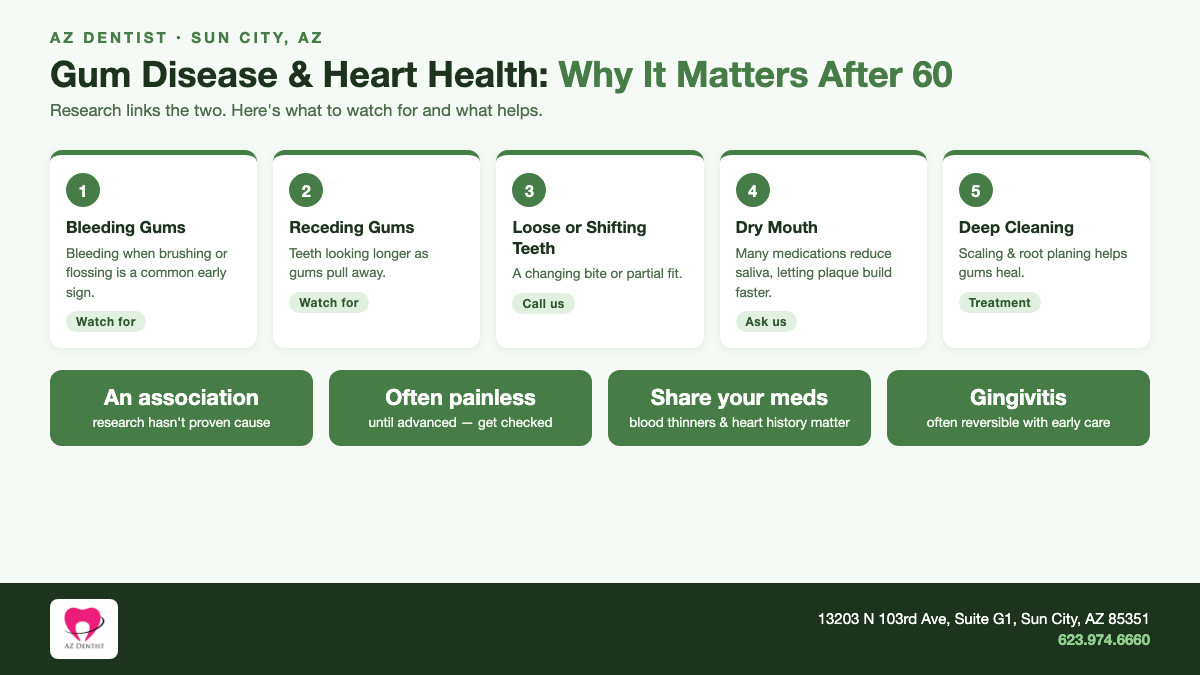
Why the Gum Disease Heart Health Link Matters More After 60 in Sun City
Gum disease becomes more common as we get older, and several things that often come with our later decades can tip the balance. Here’s what I see most often with Sun City patients.
Years of wear add up. Gum recession and bone loss tend to build gradually over time, so small problems that started decades ago can show up now.
Medications can cause dry mouth. Many common medications, including some blood pressure medications, antidepressants, and allergy medicines, can reduce saliva. Saliva is your mouth’s natural rinse, and with less of it, plaque builds up faster. In Arizona’s dry climate, that can be even more noticeable.
Blood thinners can change what you notice. Many people over 60 take blood thinners or aspirin for heart health. These can make gums bleed more easily, which can either mask gum disease or make it look worse than it is. Either way, it’s worth telling us exactly what you take.
Diabetes and gum disease affect each other. Diabetes can make gum infections more likely and harder to control, and gum inflammation may make blood sugar harder to manage. If you have diabetes, your gums deserve extra attention.
Dexterity can change. Arthritis in the hands or reduced grip strength can make thorough brushing and flossing harder. That’s not a failing; it’s a reason to adjust your tools, like an electric toothbrush, a water flosser, or floss holders.
Dental work needs maintenance. Crowns, bridges, partials and dentures, and implants all need healthy gums and bone around them to stay comfortable and secure.
Warning Signs Worth Calling About
Gum disease is often painless, so watch for these quieter signals. If you’re already paying attention to the gum disease heart health connection because of a cardiac history, these are especially worth mentioning at your next visit:
- Gums that bleed when you brush, floss, or eat
- Red, swollen, or tender gums
- Persistent bad breath or a bad taste in your mouth
- Gums that seem to be pulling away from your teeth, making teeth look longer
- Loose teeth, or teeth that seem to be shifting
- A change in how your teeth fit together when you bite, or how your partial fits
- Pus between your teeth and gums
Any of these deserve a visit. And if you have swelling in your face, a fever, or trouble swallowing or breathing, seek urgent care right away.
How We Treat Gum Disease at Our Sun City Office
The right treatment depends on how far things have progressed, and I’ll always explain what I’m seeing before we start.
A thorough exam. We measure the pockets around each tooth, check for bleeding and recession, and take X-rays to look at the bone. This gives us a clear baseline.
Professional cleaning. For gingivitis, a regular dental cleaning in Sun City plus better home care is often enough to turn things around.
Deep cleaning (scaling and root planing). For periodontitis, we clean below the gumline to remove tartar and smooth the root surfaces so the gums can heal and reattach. The area is numbed for comfort, and it’s often done in sections.
Periodontal maintenance. After treatment, many patients benefit from more frequent cleanings, often every three or four months, to keep things stable.
Replacing teeth that couldn’t be saved. If gum disease has already cost you teeth, there are good options. Once your gums are healthy, we can talk about dental implants in Sun City, bridges, or implant-supported dentures, depending on your needs.
Throughout, I’m happy to coordinate with your physician or cardiologist, because good gum disease heart health care works best when your dentist and your doctors share notes. With your permission, we’ll keep them in the loop so your care team is working together. Treating the whole person is something I believe in deeply; I came to dentistry by way of social work, and I’ve never stopped thinking of patients as people first.
Healthy gums are part of healthy aging. Book your gum check today.
AZ Dentist Sun City — 13203 N 103rd Ave, Suite G1, Sun City, AZ 85351
Direct line: 623.974.6660 | Main line: (602) 638-2539
Simple Daily Habits That Protect Your Gums
You don’t need a complicated routine to support both sides of the gum disease heart health picture. These everyday steps make a real difference, and they’re the same advice I give my own family:
- Brush twice a day for two minutes with a soft brush and fluoride toothpaste. An electric toothbrush can make this easier, especially with arthritis.
- Clean between your teeth once a day. Floss, floss picks, interdental brushes, or a water flosser all count. Pick the one you’ll actually use.
- Sip water throughout the day, especially if you take medications that dry your mouth. Ask us about saliva substitutes if dryness is a problem.
- Don’t smoke, and if you do, ask your doctor about resources for quitting. Smoking is one of the strongest risk factors for gum disease.
- Keep diabetes and other health conditions well managed with your physician.
- Clean your partial or denture daily, and take it out at night unless we’ve advised otherwise.
- Keep up with regular cleanings and exams so we can catch changes early.
MedlinePlus, from the National Library of Medicine, also has a good patient page on gum disease with additional tips.

Frequently Asked Questions
Does gum disease cause heart disease?
Research has found an association between gum disease and heart disease, but it hasn’t proven that one causes the other. Inflammation, oral bacteria, and shared risk factors like smoking and diabetes may all play a role. What we do know is that keeping your gums healthy is good for your mouth and part of caring for your overall health. When patients ask about the gum disease heart health link, I encourage them to talk with both their dentist and their physician.
Should I tell my dentist about my heart condition and medications?
Yes, always. Heart conditions, blood thinners, and other medications can affect bleeding, healing, and how we plan your care. Some patients with certain heart conditions may need antibiotics before some dental procedures, based on guidance from their physician. Bring an updated medication list to every visit.
Can gum disease be reversed?
Gingivitis, the early stage, is often reversible with professional cleanings and good daily care. Periodontitis can’t usually be fully reversed, because lost bone doesn’t typically grow back on its own, but it can often be controlled with deep cleaning and regular maintenance so it doesn’t progress.
Does Medicare cover gum disease treatment in Sun City?
Original Medicare generally doesn’t cover routine dental care, including most gum disease treatment. Some Medicare Advantage plans include dental benefits that may cover cleanings and some periodontal care. Bring your plan information and our Sun City team will help you understand your coverage. We also offer CareCredit and Cherry financing.
The Bottom Line for Sun City Patients
The gum disease heart health connection is still being studied, but the practical takeaway is clear: healthy gums are worth protecting, especially after 60. If your gums bleed, feel tender, or just haven’t been checked in a while, come see us. Come as a patient, leave as a friend, and leave knowing exactly where your gum health stands.
— Janne Lynch, DDS, practices at AZ Dentist’s Glendale, Scottsdale, Sedona, and Sun City offices. Connect with her on LinkedIn.
This article is educational and isn’t dental or medical advice. It does not replace guidance from your physician or cardiologist. Please contact us or your own providers about your specific situation before making treatment decisions.
Sun City, take care of your gums, and they’ll take care of you.
AZ Dentist Sun City — 13203 N 103rd Ave, Suite G1, Sun City, AZ 85351
Call: 623.974.6660