

Fast, Safe Ways to Whiten Teeth at Home
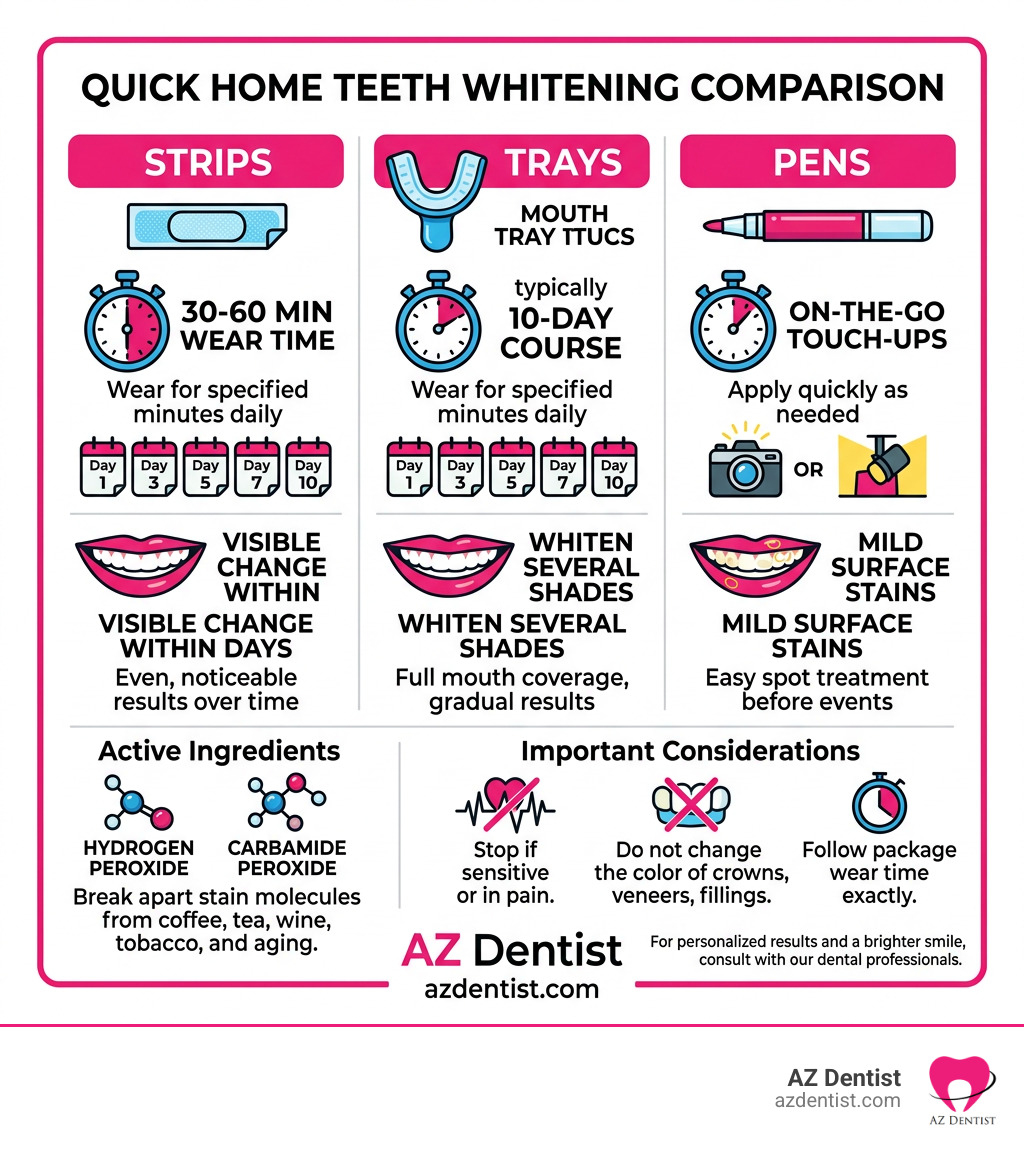
For quick teeth whitening at home, choose a peroxide-based strip or prefilled tray, follow the package wear time exactly, and stop if your teeth or gums become painful. Whitening pens are the easiest option for small, on-the-go touch-ups, while strips and trays usually give more even, noticeable results over several days.
Fast options can fit a busy schedule:
- Whitening strips: Often worn for 30 to 60 minutes; some products show visible change within days.
- Prefilled trays: Cover more tooth surface and may whiten several shades over a typical 10-day course.
- Whitening pens: Simple for touch-ups before an event, but best for mild surface stains rather than a full smile makeover.
Hydrogen peroxide and carbamide peroxide are the ingredients to look for. They break apart stain molecules from coffee, tea, wine, tobacco, and aging. They will not change the color of crowns, veneers, fillings, or other restorations, so a dental check can help you avoid an uneven result.
I’m Dr. Janne Lynch, and my work in cosmetic dentistry has taught me that quick teeth whitening at home works best when it is matched to your teeth, sensitivity level, and goals. At AZ Dentist Scottsdale, AZ Dentist Glendale, AZ Dentist Sun City, and AZ Dentist Sedona, we help patients pursue a brighter smile with a gentle, personalized approach.
Explore our guides on how to whiten teeth at home in one day, finding the most effective way to whiten teeth, and practicing safe teeth whitening for lasting results.
Top Methods for Quick Teeth Whitening at Home
When you need a noticeably brighter smile on short notice, choosing the right method makes all the difference. While drugstore aisles are packed with countless whitening toothpastes, rinses, strips, and gadgets, not every option delivers rapid, visible change. Whitening toothpastes, for example, primarily rely on mild abrasives to scrub away surface debris, but they cannot lift deeper, set-in stains within a matter of days.
To achieve genuine shade improvement rapidly, you need products that keep active bleaching agents in sustained contact with your enamel. The three most practical delivery formats for fast home care are whitening strips, prefilled trays, and precision pens.
| Whitening Method | Active Ingredients | Average Wear Time | Time to Visible Results | Best For |
|---|---|---|---|---|
| Whitening Strips | 6%–10% Hydrogen Peroxide | 15–60 minutes daily | 1 to 3 days | Even whitening across front teeth with reliable adhesion |
| Prefilled Trays | 10%–15% Hydrogen Peroxide | 30–60 minutes daily | 3 to 5 days | Full-arch coverage, reaching side teeth and molars comfortably |
| Whitening Pens | Hydrogen or Carbamide Peroxide | Brush on, dry 30 sec | Immediate minor brightness / 7 days full | Instant touch-ups before meetings, photos, or special events |
Before starting any regimen, comparing whitening methods can help you determine which delivery format best fits your timeline, budget, and sensitivity tolerance.
Choosing Whitening Strips for Quick Teeth Whitening at Home
Whitening strips remain one of the most popular and clinically proven methods for lifting stubborn discoloration. These thin, flexible polyethylene strips are coated with an enamel-safe peroxide gel that adheres directly to your teeth.
For high-speed brightening, modern strip designs fall into two primary categories:
- Traditional High-Adhesion Strips: Products such as 3DWhitestrips 1 Hour Express use advanced seal technology to lock onto enamel without slipping. These express kits are designed to whiten teeth up to 12 levels in just 10 days by using a concentrated 60-minute daily wear time. If you prefer a shorter daily routine, standard formulas like Crest 3DWhitestrips Noticeably White At-home Teeth Whitening Kit provide visible results in days with simple 30-minute treatments. Similarly, dentist-developed options like At-Home Teeth Whitening Strips – Opalescence are formulated to begin visibly lifting stains in as few as 3 days.
- Rapid Dissolvable Strips: If you dislike peeling off sticky residue after treatment, innovations like quip Rapid Dissolvable Whitening Strips offer a no-mess alternative. Formulated with 8% hydrogen peroxide and soothing ingredients like coconut oil, these strips dissolve naturally in your mouth in approximately 15 minutes, claiming up to 3x whiter teeth after the very first application.
Prefilled Trays and Whitening Pens
If strips feel awkward on your teeth or fail to cover uneven tooth alignment, prefilled trays and brush-on pens offer versatile alternatives.
- Prefilled Whitening Trays: Systems like Opalescence Go 10% Prefilled Whitening Trays feature innovative UltraFit™ tray technology. These soft, flexible trays adapt to the contours of your smile using the natural warmth of your mouth, requiring no custom lab molds or boiling. They deliver a consistent layer of 10% hydrogen peroxide gel across the entire arch, whitening teeth up to 5 shades in just 10 days while bathing the enamel in potassium nitrate to soothe sensitive nerve endings.
- Brush-On Whitening Pens: When you only have seconds to spare before walking into a wedding, photo shoot, or job interview, an Instant Whitening Pen is an ultra-portable solution. Whitening pens allow you to paint a concentrated blend of hydrogen and carbamide peroxide directly onto targeted teeth. The gel dries in about 30 seconds, breaking down surface film without requiring you to wear appliances in your mouth.
How Fast-Acting Whitening Ingredients Work
To understand how quick whitening works, it helps to look at the chemistry of a tooth stain. Your outer enamel is composed of tightly packed microscopic hydroxyapatite crystals. Over time, staining compounds known as chromogens—found abundantly in coffee, dark berries, red wine, and tobacco—embed themselves deep inside the microscopic pores of this crystalline structure.
Surface-level polishing can lift extrinsic stains resting on the surface, but intrinsic discoloration trapped within the enamel requires chemical oxidation:
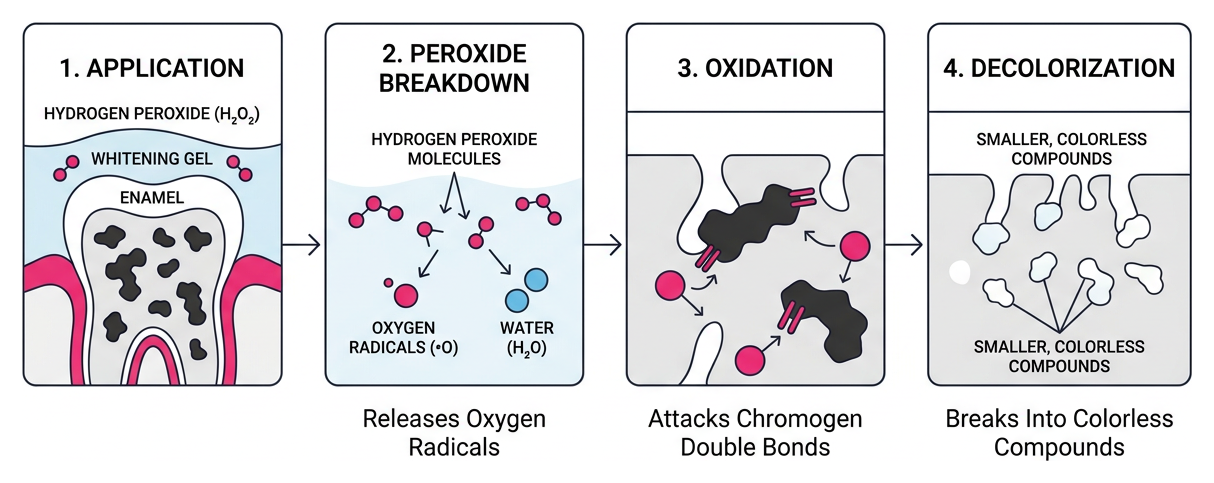
- Application: The whitening gel sits against the enamel.
- Peroxide Breakdown: Hydrogen peroxide rapidly destabilizes, releasing volatile oxygen radicals. Carbamide peroxide breaks down slightly slower, yielding approximately 3.3% hydrogen peroxide alongside urea.
- Oxidation: These free radicals penetrate the semi-permeable enamel and dentin layers, attacking the double carbon bonds of dark chromogen molecules.
- Decolorization: By cleaving these chemical bonds, the dark molecules are broken into smaller, lighter, or colorless compounds, restoring natural brilliance.
While this process is safe when performed correctly, aggressive over-application can temporarily dehydrate enamel prisms. Adhering to proven guidelines for protecting tooth enamel ensures you achieve maximum brightness without compromising the structural integrity of your teeth. For more foundational advice on safely accelerating your routine, explore our guide on fast-acting at-home whitening solutions.
Step-by-Step Guide to Maximize Results and Minimize Sensitivity
Getting the best outcome from at-home whitening requires more than simply slapping on a strip. Following a structured application protocol protects your gums, optimizes gel contact, and prevents the sharp twinges of transient sensitivity.
Step-by-Step Application Routine
To get professional-grade results from your home kit, use this clear clinical sequence:
- Clean, Don’t Scrub: Brush gently with a soft-bristled toothbrush and plain water 30 minutes before whitening to clear away plaque. Avoid brushing with abrasive toothpaste immediately before applying peroxide, as this can irritate delicate gum tissue.
- Dry Your Teeth: Wipe your front teeth with a clean tissue or cotton pad. Peroxide gels adhere significantly better and work faster when not diluted by a heavy layer of saliva.
- Precision Placement: Place the strip or tray carefully along your gumline. Avoid overlapping the gel onto your gums. If excess gel squeezes out onto your gums, wipe it away immediately with a damp cotton swab to avoid chemical blanching or irritation.
- Set a Timer: Adhere strictly to the product wear time—whether it is 15 minutes for dissolvable strips or 30 to 60 minutes for traditional trays. Leaving products on longer does not create deeper whitening; it only increases dehydration and nerve sensitivity.
- Rinse and Cleanse: Gently peel away the strip or remove the tray. Rinse your mouth thoroughly with lukewarm water. You may brush gently with a fluoride or desensitizing toothpaste to clear remaining gel residue.
- Follow the “White Diet”: Your enamel pores remain slightly open and dehydrated for 24 to 48 hours after a whitening session. Avoid dark-colored foods and beverages (coffee, soy sauce, marinara, cola, dark chocolate) during this critical window to prevent fresh stains from settling into the freshly opened pores.
Practicing this routine helps in identifying the most effective way to whiten teeth while keeping your oral tissues healthy and comfortable.
Protecting Enamel and Managing Sensitivity During Quick Teeth Whitening at Home
Tooth sensitivity during bleaching occurs because peroxide penetrates through the porous enamel rods into the dentinal tubules, temporarily stimulating the pulp nerve. Fortunately, this sensitivity is transient and completely reversible.
To manage sensitivity effectively:
- Use Potassium Nitrate: Brush with a sensitivity toothpaste containing potassium nitrate or nano-hydroxyapatite for two weeks prior to and throughout your whitening regimen. Potassium nitrate calms the nerve excitability inside the tooth pulp.
- Space Out Sessions: If you feel a mild zinging sensation, take a 24- to 48-hour break between applications. Whitening operates on cumulative exposure time, so pausing for a day will not hurt your ultimate results.
- Avoid Extreme Temperatures: Stick to room-temperature water and foods immediately following a treatment to keep hypersensitive nerves relaxed.
Frequently Asked Questions About Home Teeth Whitening
Can I whiten teeth with dental work like crowns, veneers, or braces?
Peroxide-based bleaching agents only react with organic tooth structure—meaning natural enamel and dentin. Dental restorations made from porcelain, composite resin, zirconia, or dental acrylic (such as cosmetic crowns, veneers, bonding, and bridges) will not change color with whitening treatments.
If you have restorations on your front teeth, whitening your natural teeth may cause a visible mismatch. In these cases, we recommend consulting with a dentist to plan a coordinated approach where natural teeth are brightened first, followed by replacing old restorations to match your new shade.
Regarding orthodontics, while flexible trays like Opalescence Go can technically fit over traditional wires and brackets to whiten exposed areas, strips generally cannot adhere evenly around orthodontic appliances.
How quickly can I expect to see visible results?
The speed of visible whitening depends heavily on the concentration of the active agent and the type of discoloration:
- Express Strips & Dissolvable Strips: Can show noticeable surface brightness within 1 to 3 applications (often 24 to 72 hours), making them ideal for last-minute events.
- 10-Day Tray & Strip Systems: Full courses generally yield a 5- to 12-shade improvement by day 10, resolving deeper intrinsic yellowing from years of dietary staining.
- Stubborn Discoloration: Gray or brown intrinsic stains (such as those caused by past tetracycline use or fluorosis) respond much more slowly to over-the-counter strengths and typically require extended, professionally supervised protocols.
Are dentist-dispensed whitening options more effective than over-the-counter kits?
While drugstore kits are convenient for modest shade improvements, dentist-dispensed systems offer distinct advantages in speed, comfort, and uniform coverage:
- Custom Precision: In-office custom trays are fabricated from detailed 3D digital impressions of your mouth, sealing the bleaching gel precisely against your enamel while preventing any leakage onto the sensitive gums.
- Higher Active Potency: Professional take-home gels feature optimized concentrations of carbamide and hydrogen peroxide buffered with desensitizing agents, yielding faster results with less gum irritation.
- Comprehensive Safety: Having a clinical examination before whitening ensures you do not inadvertently apply strong bleaching gels over untreated cavities, cracked enamel, or active periodontal disease.
Conclusion
Quick at-home teeth whitening can provide a dramatic boost in self-confidence, helping you look and feel your absolute best for life’s biggest milestones. Whether you choose fast-acting dissolvable strips for a sudden event or conformable prefilled trays for a 10-day smile transformation, following proper application steps and protecting your enamel will ensure a bright, radiant outcome without unnecessary sensitivity.
If you have existing dental restorations, severe intrinsic discoloration, or frequent tooth sensitivity, professional guidance is the safest path to achieving your dream smile. At AZ Dentist, we love helping our patients achieve the smile of a lifetime in a welcoming, relaxed environment where you come as a patient and leave as a friend.
Whether you visit us at AZ Dentist Scottsdale, AZ Dentist Glendale, AZ Dentist Sun City, or AZ Dentist Sedona, our experienced team is here to tailor the ideal treatment for your unique goals. Explore our comprehensive professional teeth whitening services or schedule a visit today to discover how easy and comfortable achieving a brilliant smile can truly be!