

Click. Pop. That little sound when you open wide for a sandwich or yawn first thing in the morning. For some people it’s barely noticeable; for others it comes with an aching jaw, headaches, or a face that feels tired by the end of the day. I’m Dr. Janne Lynch, and at our Glendale office on Bell Road, jaw complaints come up more often than most people would guess. In this guide, I’ll explain why your jaw might click, which symptoms are worth paying attention to, what you can try at home, and what TMJ treatment Glendale patients can expect when they come to see us. My goal is to help you sort out what’s likely harmless from what deserves a closer look.
If your jaw has been bothering you for a while and you’ve just been living with it, you’re not alone. Let’s talk about it.
What Is the TMJ, and What Is TMD?
Your temporomandibular joints, or TMJs, are the two hinge-and-slide joints just in front of your ears that connect your lower jaw to your skull. You can feel them move if you place your fingertips there and open and close your mouth. Each joint has a small cushioning disc between the bones, and it’s surrounded by muscles that help you talk, chew, and yawn.
People often say “I have TMJ,” but technically, everyone has TMJs. When those joints or the surrounding muscles aren’t working comfortably, the problem is usually called a temporomandibular disorder, or TMD. TMD isn’t one single condition; it’s a group of problems that can involve the muscles, the joint itself, or both. The National Institute of Dental and Craniofacial Research has a detailed overview of TMD if you’d like to read more.
Why Does Your Jaw Click?
Jaw clicking is very common, and there are a few typical reasons it happens:
- The disc shifts. In some people, the small disc inside the joint sits slightly out of its usual position. As the jaw opens, the disc slips back into place, which can make a click or pop.
- Muscle tension. Tight, overworked jaw muscles, often from clenching or grinding, can change how the jaw moves and make it feel stiff or noisy.
- Joint wear. Like other joints, the TMJ can be affected by arthritis or wear over time, which may cause grinding or grating sounds.
- Past injury. A blow to the jaw, face, or chin can affect how the joint works, sometimes long after the injury.
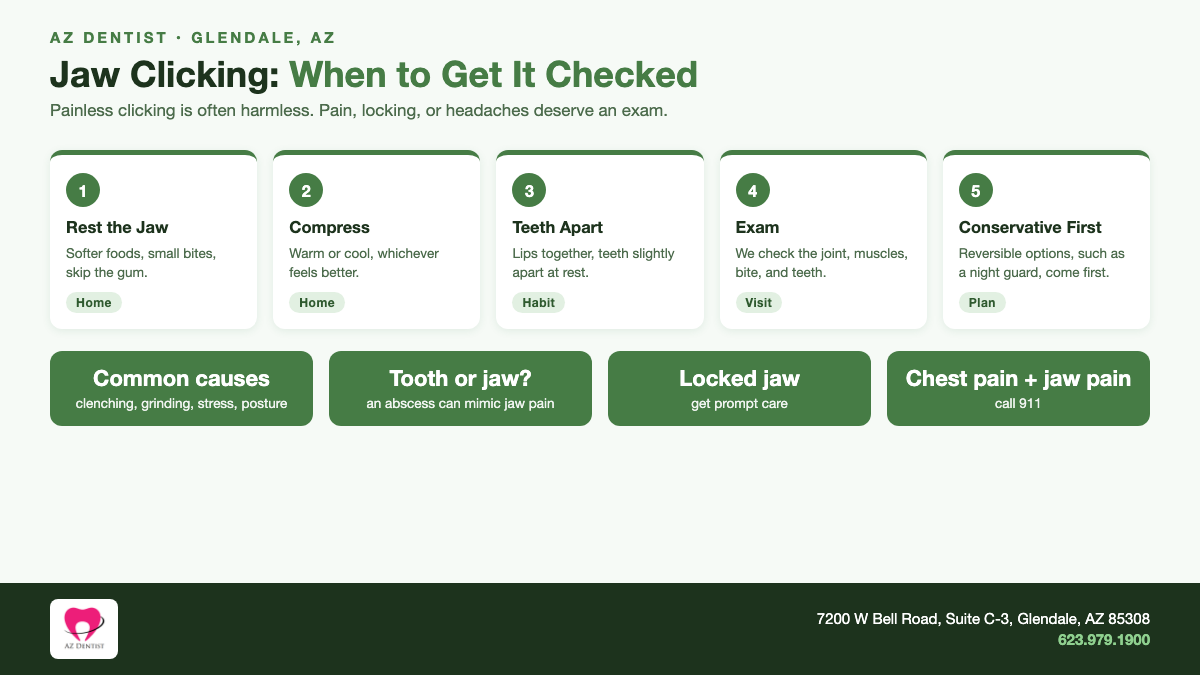
Here’s the reassuring part: a jaw that clicks but doesn’t hurt, doesn’t lock, and opens normally often doesn’t need treatment at all. Many people have a harmless click for years. It’s when clicking comes with pain, limited movement, or other symptoms that it’s worth an exam.
Symptoms That Deserve a Closer Look
If jaw clicking comes along with any of these, it’s worth calling to ask about the TMJ treatment Glendale patients can get close to home:
- Pain or tenderness in the jaw, face, or around the ears
- Headaches, especially in the temples or when you wake up
- Jaw muscles that feel tired or tight after eating or talking
- Difficulty opening your mouth wide
- A jaw that catches, sticks, or briefly locks open or closed
- A change in how your upper and lower teeth fit together
- Worn, flattened, or chipped teeth, which can be a sign of grinding
One important note: tooth problems can sometimes feel like jaw pain, and jaw problems can feel like a toothache. An infected or abscessed tooth, for example, can cause pain that spreads to the jaw and ear. That’s one of the reasons a dental exam is a smart first step. We can help figure out whether the source is a tooth, the joint, the muscles, or something else.
Jaw clicking with pain or headaches? Let’s find out what’s going on.
AZ Dentist Glendale — 7200 W Bell Road, Suite C-3, Glendale, AZ 85308
Call us directly: 623.979.1900
Common Causes and Triggers of Jaw Pain
The exact cause of TMD isn’t always clear, and it’s often a mix of factors. Some of the most common contributors I see include:
- Clenching and grinding. Many people clench during the day without noticing, especially at a computer or in traffic, and grind at night while asleep.
- Stress. Stress often shows up in the jaw. As a mom of five, I can personally vouch that a hectic week can leave your jaw muscles sore.
- Chewing habits. Chewing gum all day, biting nails, chewing on pens, or always chewing on one side can overwork the muscles.
- Posture. Long hours looking down at a phone or leaning toward a screen may strain the neck and jaw muscles.
- Injury or arthritis. As mentioned above, these can affect the joint directly.
Because several of these factors often overlap, I find it helps to keep a short symptom diary for a week or two before your visit. Jot down when your jaw hurts, what you were doing, how you slept, and whether you noticed clenching. That simple record makes the TMJ treatment Glendale patients receive much more personal, because it shows us patterns we might not catch in a single appointment.
Gentle Home Care That Often Helps
For many people, jaw discomfort improves with simple, conservative steps. These are the same tips I’d give my own family:
- Rest your jaw. Choose softer foods for a while, cut food into small bites, and avoid very chewy or hard foods.
- Skip the gum. Constant chewing keeps tired muscles working.
- Try warm or cool compresses. Many people find a warm, moist compress soothing for tight muscles. A cool pack may help some people with soreness. Use whichever feels better, wrapped in a cloth.
- Notice your resting position. At rest, your lips can be together while your teeth stay slightly apart. Teeth touching all day usually means clenching.
- Avoid extreme opening. Support your chin when you yawn and avoid wide-open bites when your jaw is sore.
- Manage stress. Gentle stretching, walks, and good sleep help your whole body, jaw included.
Over-the-counter pain relievers may help some people for short periods; check with your pharmacist or physician about what’s safe for you. If symptoms don’t improve within a couple of weeks, or they’re getting worse, it’s time to come in. The TMJ treatment Glendale patients start with us usually begins with a simple, unhurried exam.
What TMJ Treatment Glendale Patients Can Expect From Us
TMJ treatment Glendale patients receive at our office starts with listening. I want to hear when your symptoms started, what makes them better or worse, and how they affect your daily life. From there, a typical visit includes:
1. A careful exam
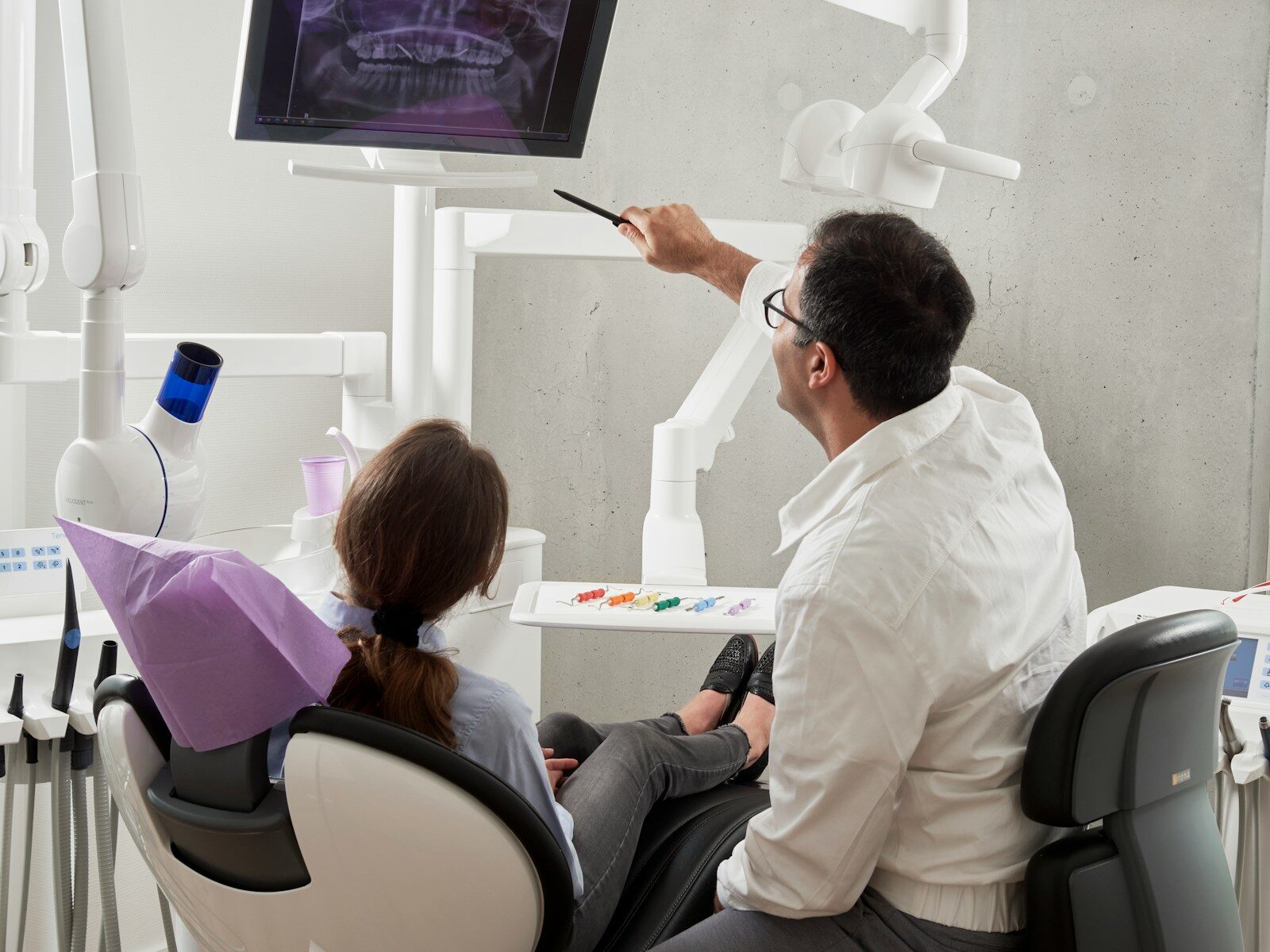
We check how your jaw opens and closes, listen and feel for clicking, look for tender muscles, examine your bite, and look for signs of grinding such as worn or cracked teeth. X-rays help us rule out tooth problems that might be causing or adding to the pain.
2. Ruling out tooth causes
If a damaged tooth is part of the problem, treating it may bring relief. That could mean anything from smoothing a rough edge to restoring a cracked tooth with one of our dental crowns in Glendale.
3. Conservative, reversible options first
Most experts, including the NIDCR, recommend starting with conservative, reversible treatments. For many patients who clench or grind, that may include a custom night guard or oral appliance to reduce strain on the teeth and jaw, along with the home-care steps above. Ask us which TMJ treatment options our Glendale office offers.
4. Coordinating with other providers when needed
Some jaw problems are best managed as a team. Depending on your symptoms, we may suggest seeing your physician, a physical therapist familiar with jaw problems, or a specialist. I’d always rather point you in the right direction than guess.
Many people who start TMJ treatment Glendale dentists recommend with these conservative steps find their symptoms ease over time. Results vary, and some people need a combination of approaches, but the first steps are usually simple. MedlinePlus has a helpful page on temporomandibular disorders with more plain-language information.
Waking up with a sore jaw? Ask whether a night guard could help.
AZ Dentist Glendale — 7200 W Bell Road, Suite C-3, Glendale, AZ 85308
Direct line: 623.979.1900 | Main line: (602) 638-2539
When Jaw Pain Is Urgent
Most jaw clicking isn’t an emergency, but some situations need prompt attention:
- Your jaw is locked open or closed and won’t release.
- You’ve had an injury to the face or jaw and your bite suddenly feels different, or you have significant swelling or pain. Head to an emergency room first if there’s a possible fracture, heavy bleeding, or any head injury symptoms.
- You have swelling, fever, or throbbing pain that could signal a dental infection. Our Glendale emergency dentist team holds same-day time for painful situations like these.
Jaw pain that comes with chest pain, shortness of breath, or pain spreading to the arm can be a sign of a heart problem. Call 911 right away in that situation.
Frequently Asked Questions
Should I worry if my jaw clicks but doesn’t hurt?
Often, no. Painless clicking is common and frequently doesn’t need treatment. Mention it at your next checkup so we can note it and keep an eye on it. If it starts to hurt, lock, or limit how wide you can open, schedule a visit.
Can TMJ problems go away on their own?
Many jaw symptoms improve on their own or with simple home care, especially when they’re linked to a stressful period or a temporary habit. Symptoms that last more than a couple of weeks or keep coming back are worth having checked.
Does a night guard help TMJ pain?
For many people who clench or grind, a custom night guard can reduce strain on the jaw and protect teeth from wear. It doesn’t help everyone, and it’s not the right tool for every type of jaw problem, which is why an exam comes first.
How do I start TMJ treatment in Glendale?
Starting TMJ treatment Glendale patients need is easy. Call our Glendale office at 623.979.1900 or request a time online. Let us know when you book that you’re having jaw symptoms so we can plan enough time to evaluate your jaw, muscles, teeth, and bite.
Your Next Step for a Calmer Jaw
A clicking jaw is often nothing to worry about, but pain, headaches, and a jaw that sticks deserve attention. TMJ treatment Glendale patients receive at our office begins with an honest exam, conservative options first, and a plan that fits your life. I was once a nervous dental patient myself, so I promise we’ll go at your pace. Come as a patient, leave as a friend, and leave with a jaw that feels more at ease.
— Janne Lynch, DDS, practices at AZ Dentist’s Glendale, Scottsdale, Sedona, and Sun City offices. Connect with her on LinkedIn.
This article is educational and isn’t dental or medical advice. Jaw pain has many possible causes, and treatment needs and results vary. Please contact us, your physician, or your own provider for guidance about your specific situation.
Glendale, don’t just live with a painful jaw. Let’s take a look.
AZ Dentist Glendale — 7200 W Bell Road, Suite C-3, Glendale, AZ 85308
Call: 623.979.1900