

Why Mouthguards Matter More Than You Think
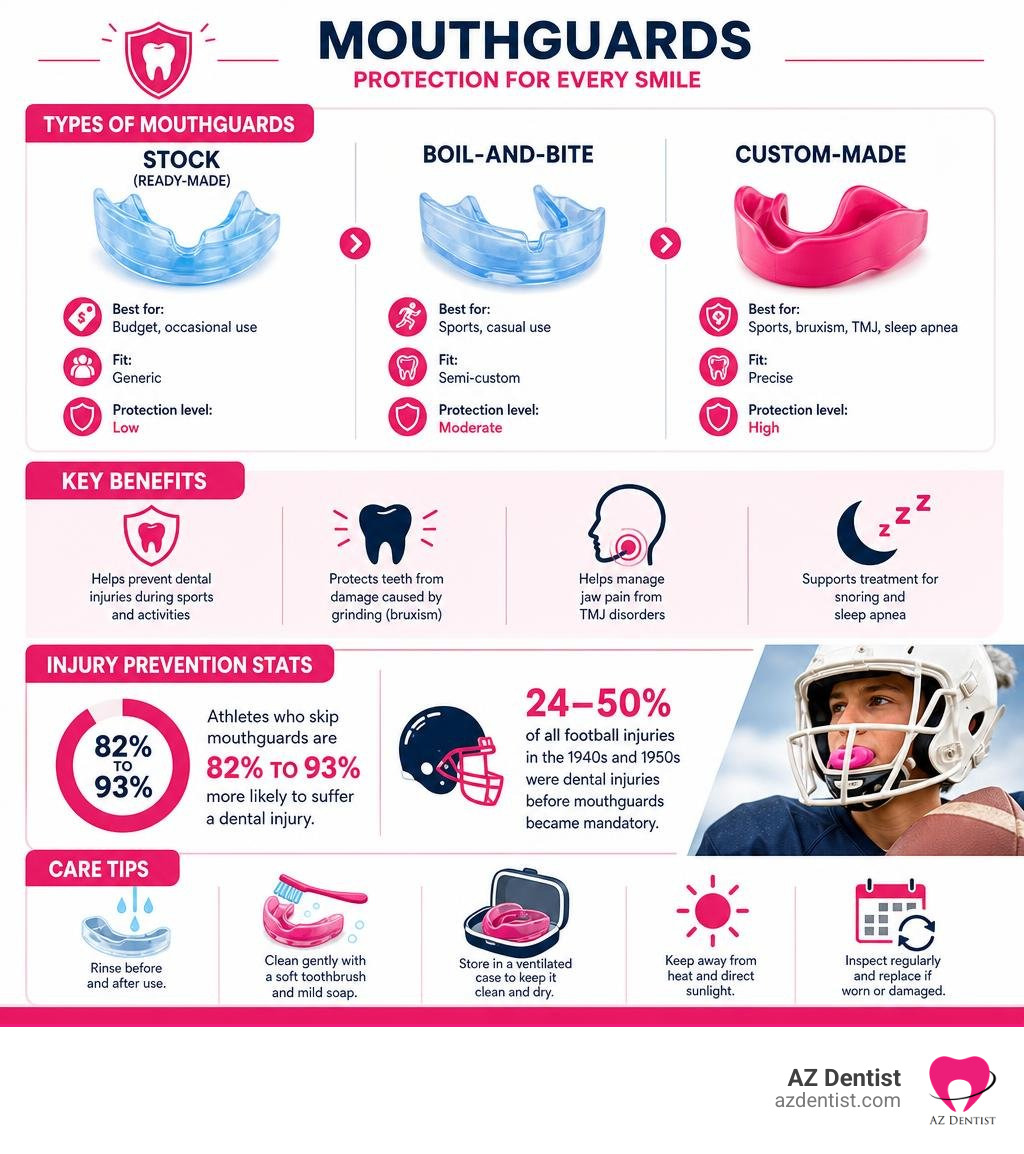
Mouthguards are removable dental appliances that cover your teeth to protect them from injury, grinding, or other dental health issues. Here’s a quick overview of what you need to know:
| Type | Best For | Fit | Protection Level |
|---|---|---|---|
| Stock (ready-made) | Budget, occasional use | Generic | Low |
| Boil-and-bite | Sports, casual use | Semi-custom | Moderate |
| Custom-made | Sports, bruxism, TMJ, sleep apnea | Precise | High |
Key uses:
- Preventing dental injuries during contact and non-contact sports
- Protecting teeth from damage caused by nighttime grinding (bruxism)
- Managing jaw pain from TMJ disorders
- Supporting treatment for snoring and sleep apnea
The numbers are hard to ignore. Athletes who skip mouthguards are between 82% and 93% more likely to suffer a dental injury. In fact, before mouthguards became mandatory in American football, dental injuries made up 24–50% of all football injuries in the 1940s and 1950s. That’s a staggering figure — and one that changed the sport forever.
A mouthguard is one of the simplest, most affordable ways to protect your smile. Yet many people still go without one — whether they’re playing sports, grinding their teeth at night, or dealing with jaw tension.
This guide covers everything: the different types of mouthguards, what they treat, what they’re made of, and how to care for them properly. Whether you’re an athlete, a nighttime grinder, or just curious, you’ll find clear answers here.
I’m Dr. Janne Lynch, and at AZ Dentist Scottsdale, AZ Dentist Glendale, AZ Dentist Sun City, and AZ Dentist Sedona, I’ve helped countless patients find the right mouthguards to protect their teeth and improve their quality of life. My background in both cosmetic dentistry and oral surgery gives me a well-rounded perspective on just how much damage a missing mouthguard can cause — and how much a well-fitted one can prevent.
Understanding the Different Types of Mouthguards
To choose the best protection for your teeth, it helps to understand how different mouthguards are constructed and how they perform. While every mouthguard serves as a barrier, the fit, comfort, and degree of shock absorption vary wildly across the three primary categories: stock, boil-and-bite, and custom-made.
| Feature | Stock Mouthguards | Boil-and-Bite Mouthguards | Custom-Made Professional Guards |
|---|---|---|---|
| Fit & Retention | Poor; loose-fitting; requires clenching | Moderate; semi-customized at home | Superior; exact anatomical replication |
| Speech & Breathing | Highly restrictive | Mildly restrictive | Completely unrestricted |
| Durability | Low; wears out in weeks | Moderate; lasts a few months | High; lasts several years with proper care |
| Primary Materials | Low-grade rubber or plastic | Standard thermoplastic polymers | Medical-grade EVA, PolyShok™, or PET-G |
| Protection Level | Minimal | Basic | Maximum (multi-layered) |
Choosing the wrong type can result in a guard that sits in your gym bag or bedside drawer instead of protecting your smile. Let’s break down these categories so you can make an informed decision.
Stock and Boil-and-Bite Mouthguards
Stock mouthguards are prefabricated, off-the-shelf options found in most sporting goods stores. They are inexpensive and ready to wear immediately, but they come in generic sizes (small, medium, large) that rarely match anyone’s dental arch. Because they do not grip the teeth, you must constantly clench your jaw to keep them in place. This makes breathing and speaking incredibly difficult, which is why we rarely recommend them for serious athletic activity or therapeutic use.
A step up from stock is the “mouth-adapted” or boil-and-bite mouthguard. These are made from thermoplastic polymers that soften when submerged in boiling water. Once softened, you place the guard in your mouth and use your fingers, tongue, and biting pressure to mold it around your teeth.
While boil-and-bite options offer a vastly superior fit compared to stock guards, they still have notable downsides. They can be bulky, and the process of molding them at home can be tricky. If you bite down too hard during the molding process, you can easily bite right through the material, leaving thin spots that offer little to no protection.
If you are looking for an over-the-counter solution specifically for teeth grinding, you can read more about selecting these options in The Strategists Pick Best Over The Counter Mouth Guards For Grinding. Additionally, if you decide to go this route, following a structured approach is critical to achieving a decent fit; check out our Step By Step Guide To Moldable Bite Guards to ensure you mold your over-the-counter guard safely without scalding your gums.
Custom-Made Professional Mouthguards
When it comes to dental protection, nothing compares to a custom-made professional mouthguard. These are fabricated by a dental professional using an exact impression or 3D digital scan of your teeth. Because they are designed to mirror your unique oral anatomy, they fit like a glove, snap securely onto your teeth, and stay in place without requiring you to clench your jaw.
There are two primary methods used to manufacture custom mouthguards:
- Vacuum-Formed: These are created by heating a single layer of thermoplastic material and vacuuming it tightly over a physical model of your teeth. They offer a great fit and are excellent for light athletic protection or basic teeth grinding.
- Pressure-Laminated: This is the gold standard for high-impact sports. Multiple layers of medical-grade materials are fused together under high pressure and heat. This process allows the technician to vary the thickness of the guard, placing extra protection in high-impact zones (like the front teeth) while keeping the biting surfaces balanced.
To learn more about the long-term savings and health benefits of professional fabrication, explore our Guide To Affordable Custom Night Guard. For a deep dive into the clinical step-by-step process of how we design these appliances to match your teeth perfectly, refer to our Custom Fitted Teeth Guard Detailed Guide.
Primary Purposes: Sports, Bruxism, and TMJ Therapy
Many people associate mouthguards strictly with high-impact sports like football or boxing. However, in modern dentistry, these oral appliances serve as highly specialized therapeutic tools. Whether you are protecting your teeth from an opponent’s elbow or shielding them from your own jaw muscles at night, a mouthguard is an essential line of defense.
Athletic Protection in Contact and Non-Contact Sports
In sports, a mouthguard acts as a shock absorber. When a blow lands on your jaw, the force is distributed across the entire dental arch rather than being concentrated on a single tooth. This drastically reduces the risk of chipped, fractured, or knocked-out teeth, as well as lacerations to your lips, tongue, and cheeks.
The clinical data compiled by organizations like the American Dental Association (ADA) highlights the protective power of these devices:
- The risk of orofacial injury is 1.6 to 1.9 times higher in athletes who do not wear a mouthguard.
- The prevalence of dental trauma among mouthguard users is only 7.5% to 7.75%, compared to a staggering 48.31% to 59.48% among non-users.
- College basketball players wearing custom-fitted mouthguards have a dental injury rate that is five times lower than those who go unprotected (0.12 vs. 0.67 injuries per 1,000 exposures).
- Some studies suggest that mouthguard non-users have a 25% higher risk of sustaining a concussion, as a properly fitted guard cushions the jaw joint and limits the transmission of impact forces to the skull.
The ADA officially recommends mouthguards for 29 different sports. This includes obvious contact sports like hockey, rugby, and martial arts, but also non-contact, high-velocity activities like gymnastics, bicycling, and ice skating where falls are common. For parents and young athletes looking to understand how to get started with athletic protection, we recommend checking out our Beginners Guide To Mouthguards For Sports.
Managing Bruxism and TMJ Disorders
Beyond the sports arena, millions of people suffer from nocturnal bruxism (unconscious teeth grinding and clenching during sleep). The force exerted by the human jaw during sleep can exceed 250 pounds of pressure per square inch. Over time, this intense pressure can wear down tooth enamel, fracture expensive dental work (such as crowns, bridges, and dental implants), and cause severe jaw pain.
To prevent this, we use therapeutic mouthguards often referred to as nightguards or occlusal splints. Rather than absorbing sudden athletic impacts, these guards are designed to:
- Provide a smooth, durable barrier that prevents upper and lower teeth from grinding directly against one another.
- Decompress the temporomandibular joint (TMJ), reducing strain on the surrounding jaw muscles.
- Distribute clenching forces evenly across the entire bite to prevent localized tooth fractures.
If you suspect you grind your teeth, reading our comprehensive Sleep Mouth Guard For Grinding Teeth Guide is an excellent starting point. For those experiencing chronic jaw clicking, tension, or migraines, understanding the relationship between your appliance and joint health is vital; you can discover how a custom splint can bring relief by reading The Jaw Dropping Truth Why A Custom Night Guard Is Your Tmjs Best Friend. Additionally, you can explore targeted relief strategies in our resource on All About Mouth Guards For Jaw Tension.
Materials, Technology, and Maintenance Guidelines
The performance of any mouthguard is directly tied to the materials from which it is made and the technology used to fabricate it. Modern dental science has moved far beyond the rigid, uncomfortable plastics of the past. Today, we utilize advanced polymers engineered for maximum safety, durability, and biocompatibility.
Advanced Polymers and 3D Printing
Historically, custom dental appliances required taking messy, uncomfortable physical impressions using alginate or silicone putty. This process often triggered a gag reflex and left room for minor distortions.
Today, we can utilize advanced handheld intraoral scanners to capture a highly detailed 3D digital model of your teeth in under ten minutes. This digital file is sent directly to a specialized laboratory where we can use 3D printing technology or precision milling to create your appliance.
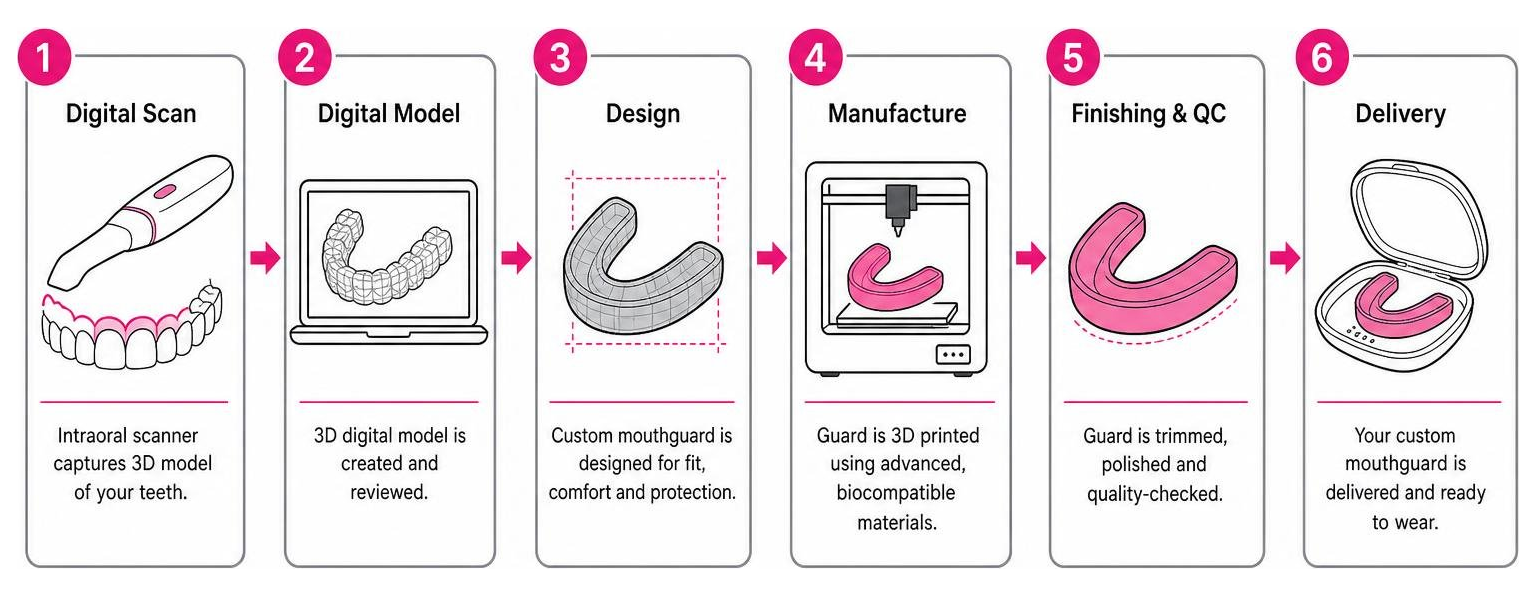
The materials we use are equally advanced:
- Ethylene-Vinyl Acetate (EVA): This is the industry standard for custom sports mouthguards. EVA is highly valued for its elastomeric properties, meaning it remains flexible and comfortable while offering exceptional shock absorption.
- PolyShok™: An ASTM-tested polymer blend designed specifically for athletic use. It is engineered to be over 150% more shock-absorbent than traditional EVA materials, allowing us to create thinner, more comfortable guards that offer superior protection.
- PET-G (Polyethylene Terephthalate Glycol): A highly durable, rigid thermoplastic often used as an outer shell in multi-layered guards to resist heavy biting forces and impact.
Proper Fit, Care, and Cleaning Protocols
No matter how advanced your mouthguard is, it will only protect you if it remains clean, hygienic, and structurally sound. Because mouthguards spend hours in a warm, moist environment, they can easily become a breeding ground for bacteria, yeast, and mold if neglected.
To ensure your appliance remains safe and lasts for its intended lifespan, follow these daily maintenance guidelines:
- Clean immediately after use: Rinse your mouthguard in cool or lukewarm water as soon as you take it out of your mouth. Avoid hot water, as extreme heat can warp the thermoplastic material and ruin the custom fit.
- Brush gently: Use a soft-bristled toothbrush and mild, non-abrasive soap (like liquid dish soap or baby shampoo) to clean all surfaces of the guard. Avoid standard toothpastes, as they contain abrasive particles that can scratch the plastic, creating microscopic grooves where bacteria can hide.
- Air dry completely: Before storing your mouthguard, let it air dry completely on a clean surface. Storing a wet mouthguard in a closed case promotes rapid bacterial growth.
- Use a ventilated case: Always store your guard in a sturdy, ventilated plastic case. This protects it from physical damage and allows any residual moisture to evaporate.
- Keep away from pets: Dogs and cats are naturally attracted to the scent of saliva on oral appliances. Countless mouthguards are destroyed every year by family pets chewing on them.
- Bring it to your dental checkups: Whenever you visit us for a routine cleaning, bring your mouthguard along. We will professionally clean it and inspect it for micro-fractures, wear, or changes in your bite.
Frequently Asked Questions
Navigating oral appliances can raise many questions. Here are some of the most common queries we receive from patients at our Glendale, Scottsdale, Sedona, and Sun City locations.
Can I wear a mouthguard with braces or dental implants?
Yes, and in fact, it is highly recommended. If you wear orthodontic braces, a blow to the face can cause the metal brackets to lacerate the inside of your lips and cheeks. Furthermore, a hard impact can damage the brackets themselves, delaying your orthodontic treatment.
However, you should never use a standard, self-molded boil-and-bite guard if you have braces. The cooling plastic can grip the brackets and wires, making the guard impossible to remove without damaging your orthodontic work. Instead, athletes with braces require specialized guards that fit comfortably over the brackets without interfering with tooth movement. To learn more about orthodontic-specific protection, read our guide on the Best Mouthguard For Braces.
Similarly, if you have dental implants, crowns, or bridges, a custom mouthguard is essential. Implants do not have the natural shock-absorbing periodontal ligament that natural teeth possess, making them more vulnerable to fracture under extreme clenching or impact forces. A custom-fit guard distributes these forces safely, protecting your investment.
How long does a custom-fit mouthguard last?
The lifespan of a mouthguard depends heavily on how often it is used, how well it is maintained, and whether the wearer is still growing.
For adults, a high-quality, custom-made sports mouthguard or nightguard can easily last several years with proper maintenance. However, for growing children and teenagers, a mouthguard may need to be replaced every season or every six months to accommodate natural dental and jaw growth. Wearing a guard that no longer fits can restrict jaw development or cause tooth soreness.
Over-the-counter options wear out much faster and typically require replacement every few months. For a detailed breakdown of what to expect in terms of wear, tear, and replacement timelines, consult our Dentist Night Guard Top 2026 Guide.
Does dental insurance cover the cost of custom guards?
In many cases, yes. Many private dental insurance policies cover a portion—or even the entirety—of the cost of a custom-fabricated oral appliance, especially if it is deemed medically necessary to treat severe bruxism, TMJ disorders, or sleep apnea.
Additionally, you can use Health Savings Account (HSA) or Flexible Spending Account (FSA) funds to purchase both custom-fitted and store-bought mouthguards. Because insurance policies vary widely, we recommend contacting your provider or speaking with our administrative team to verify your benefits. For helpful tips on navigating these costs and finding budget-friendly professional options, refer to our Affordable Night Guard Dentist Guide 2026.
Conclusion
At the end of the day, your smile is one of your most valuable assets. Whether you are hitting the field for a high-impact game, managing chronic jaw pain, or simply looking to protect your teeth from the destructive forces of nighttime grinding, a high-quality mouthguard is a simple, highly effective solution.
While over-the-counter boil-and-bite options can serve as a temporary band-aid, they cannot match the safety, durability, and sheer comfort of a professionally fabricated appliance. A guard that fits perfectly is a guard you will actually wear.
I’m Dr. Janne Lynch, and our entire team across our Arizona locations is dedicated to providing you with the comfortable, compassionate care you deserve. We want you to “come as a patient, leave as a friend,” and walk away with the smile of a lifetime.
If you are ready to experience the difference that a custom-fit appliance can make for your health, comfort, and peace of mind, we invite you to explore our specialized Services/Night Guard page or contact us today to schedule your consultation at our Glendale, Scottsdale, Sedona, or Sun City locations!