

What Is a Dental Implant Specialist — and Do You Need One?
A dental implant specialist is a dentist with advanced surgical and restorative training focused on replacing missing teeth with implants that look, feel, and function like natural teeth.
Here’s a quick overview of what you need to know:
| Question | Quick Answer |
|---|---|
| What do they do? | Place and restore artificial tooth roots into the jawbone |
| Who qualifies as one? | Oral surgeons, periodontists, prosthodontists, or dual-certified specialists |
| Do I need a specialist vs. a general dentist? | For complex cases, yes — specialist training significantly improves outcomes |
| What’s the first step? | A consultation with a CBCT scan to evaluate your bone and overall oral health |
| How long do implants last? | 30+ years with proper care and hygiene |
Losing a tooth — or several — affects more than just your smile. It changes the way you eat, speak, and feel about yourself. It can also trigger jawbone loss that quietly reshapes your face over time. Dental implants are widely considered the gold standard solution for tooth loss because they replace the root, not just the visible tooth. But getting the right outcome depends heavily on who performs the procedure.
That’s where finding a qualified specialist matters most.
I’m Dr. Janne Lynch, and at AZ Dentist Scottsdale, AZ Dentist Glendale, AZ Dentist Sun City, and AZ Dentist Sedona, I work closely with trusted dental implant specialists to help patients find the right care for their unique needs. My training at NYU’s College of Dentistry — combined with hands-on surgical experience in oral surgery — gives me a strong foundation for guiding patients through the implant process with clarity and confidence.
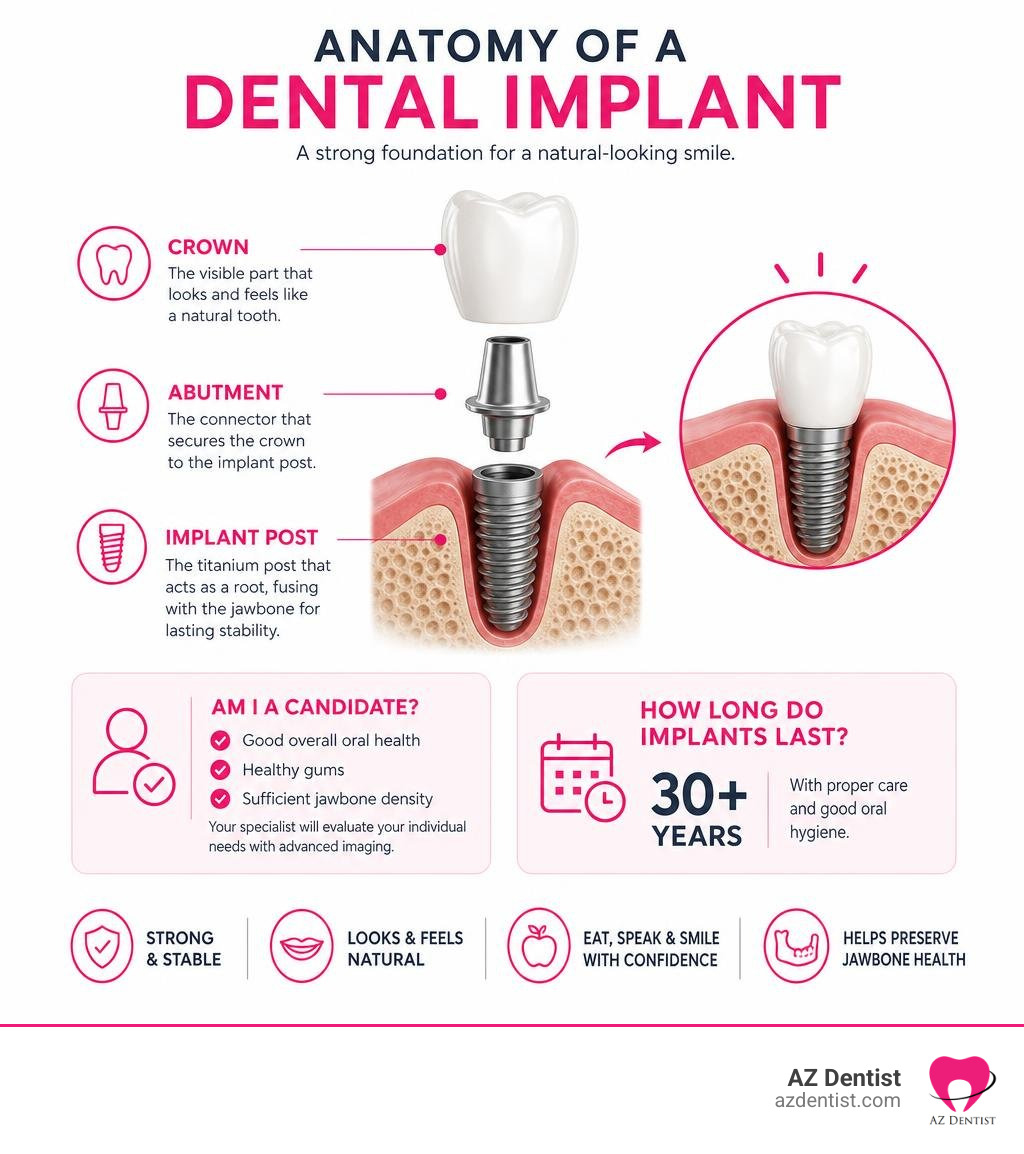
Dental implant specialist terms you need:
Understanding the Role of a Dental Implant Specialist
When you begin searching for a dental implant specialist, you will quickly notice that “implantologist” is not a single, isolated dental degree. Instead, dental implantology is a highly specialized field practiced by a few distinct dental professionals.
Historically, dentists operated entirely within separate offices, referring patients back and forth for different phases of treatment. Today, modern implantology relies on a highly collaborative, interdisciplinary team approach. This model brings together surgical precision and restorative artistry to ensure your new teeth are both structurally sound and beautiful.
At AZ Dentist, we believe in this seamless partnership. We coordinate your care from your very first consultation to the final placement of your custom-crafted crown, bridge, or overdenture.
Why You Need a Board-Certified Dental Implant Specialist
While any licensed dentist can legally place a dental implant, choosing a board-certified specialist or a dentist with extensive, formal post-graduate residency training dramatically increases your chances of a successful, lifelong outcome.
Board certification is an elective, rigorous credentialing process. It indicates that a practitioner has undergone hundreds of hours of continuing education, submitted successful real-world cases for peer review, and passed demanding written and oral examinations.
For instance, organizations such as the American Board of Oral Implantology (ABOI/ID) or the International Congress of Oral Implantologists (ICOI) award Diplomate status only to those who demonstrate the highest level of competence. In fact, fewer than 600 dentists in the United States hold Diplomate-level board certification in oral implantology, making this a key indicator of elite expertise. When you trust your smile to a highly trained specialist, you are ensuring that your provider is prepared for any anatomical variation or unexpected surgical complexity.
Periodontist vs. Oral Surgeon vs. Prosthodontist
To choose the right provider, it helps to understand the “Big Three” dental specialties involved in implant dentistry:
- Periodontists: These specialists focus on the soft tissues (gums) and the supporting bone structures of your mouth. They are experts in treating periodontal disease, performing soft tissue grafting, and preparing the jawbone through advanced bone grafting. Their surgical training makes them exceptionally skilled at placing the titanium implant post securely into the bone while preserving gum health.
- Oral and Maxillofacial Surgeons: These dental specialists complete intensive, hospital-based surgical residency programs (often holding dual DDS/DMD and medical MD degrees). They are the experts to see for complex surgical extractions, jaw reconstruction, sinus lifts, and advanced sedation options.
- Prosthodontists: If periodontists and oral surgeons are the “architects and structural engineers” who lay the foundation, prosthodontists are the “interior designers and master builders.” They undergo years of advanced training dedicated to the highly aesthetic and functional restoration of missing teeth, designing the custom crowns, bridges, and dentures that attach to your implants. Learn more about the scope of this specialty on Wikipedia’s Prosthodontics page.
At AZ Dentist, we frequently utilize a collaborative model where our restorative team partners with trusted local periodontal specialists and oral surgeons to ensure the surgical placement is absolutely perfect before we design and place your final restoration.
How to Choose the Right Dental Implant Specialist for Your Smile
Selecting the right doctor is a personal decision. Because dental implants are a significant physical and financial investment, you should never feel rushed or pressured into a treatment plan. Whether you visit us at AZ Dentist Glendale, AZ Dentist Scottsdale, or any of our other convenient Arizona locations, we want you to feel completely confident in your care.
When researching local providers, look closely at their credentials, their years of active experience, and the technology they integrate into their daily practice. A top-tier specialist will always prioritize patient education, walking you through your 3D scans and explaining the “why” behind their recommendations.
Questions to Ask Your Dental Implant Specialist During a Consultation
Your initial consultation is your opportunity to interview your prospective doctor. We recommend bringing a list of written questions to your appointment. To help you prepare, we have put together a comprehensive guide on dental implants near me 7 questions to ask during your visit.
Here are a few essential questions you should always ask:
- What is your specific surgical and implant training? Look for university- or hospital-based residency programs rather than weekend certification courses.
- What is your personal success rate with this specific procedure? Experienced specialists generally maintain success rates above 95% to 98%.
- How do you handle pain management and dental anxiety? Ask about oral conscious sedation or IV sedation options to keep you comfortable.
- What implant materials do you use? Ensure they partner with trusted, best-in-class manufacturers utilizing medical-grade titanium or high-quality zirconia.
- What is the estimated timeline for my recovery and final restoration? A transparent provider will give you a realistic schedule based on your bone health.
- Do you handle both the surgical placement and the final restoration, or do you collaborate with another specialist? Both approaches work beautifully, but you should know who will be performing each step.
- What happens if the implant fails to integrate with my bone? Ask about their warranty and retreatment policies.
The Role of Advanced Technology in Modern Implantology
The days of relying solely on traditional 2D X-rays to plan implant surgery are long gone. Today, modern implantology is a highly digital, predictable science.
A premier dental implant specialist will utilize Cone Beam Computed Tomography (CBCT) scans. These state-of-the-art 3D scans allow us to map your exact jawbone density, locate nerve pathways, and measure the distance to your nasal sinuses with sub-millimeter precision.
With this digital data, we can perform virtual surgery on a computer screen before we ever touch a surgical instrument. Guided surgery templates are then 3D-printed to ensure the implant is placed at the exact angle and depth planned. In some advanced centers, FDA-approved robotic devices like the Yomi robotic system assist surgeons by translating these 3D scans into real-time physical navigation tools, enabling smaller incisions, less surgical trauma, and much faster recovery times.
To learn more about how these incredible technologies work together to rebuild your smile, explore our guide on how do dental implants work.
Candidacy, Risks, and the Dental Implant Process
Before embarking on your implant journey, it is vital to understand the biological factors that influence success, the potential risks involved, and what the step-by-step treatment process actually looks like.
Are You a Good Candidate for Dental Implants?
Generally, most adults in good health who are missing one or more teeth are excellent candidates for implants. However, certain biological criteria must be met:
- Adequate Jawbone Volume: When you lose a tooth, the surrounding bone naturally begins to resorb (shrink) over time. If you have been missing teeth for years, you may require a bone graft or a sinus lift (for upper teeth) to rebuild a solid foundation.
- Fully Developed Jaw: Children and teenagers are not candidates for implants because their jaws are still actively growing. Placing an implant too early can disrupt normal jaw development. Typically, we wait until age 16-17 for girls and 18-19 for boys.
- Overall Systemic Health: Chronic conditions like uncontrolled diabetes, active cancer treatments, or autoimmune diseases can slow down bone healing. However, well-managed health conditions rarely prevent patients from getting implants.
- Tobacco Use: Smoking or using tobacco products restricts blood supply to your gums and bone. This directly interferes with the healing process and increases the risk of implant failure. We strongly advise patients to quit or pause smoking before and after surgery.
If you are curious about the different styles of restorations available for your unique mouth, check out our breakdown of the various types of dental implants.
Potential Risks and Complications of Implant Surgery
Like any surgical procedure, dental implant surgery carries some minor risks. When performed by an experienced dental implant specialist, complications are incredibly rare, but it is important to be aware of them:
- Infection (Peri-implantitis): Just like natural teeth can develop gum disease, implants can develop an inflammatory condition called peri-implantitis if oral hygiene is neglected. This can lead to bone loss and eventual implant failure.
- Nerve Damage: If an implant is placed too close to a major nerve pathway, it can cause temporary or permanent numbness, tingling, or discomfort in your lips, chin, or gums. Advanced CBCT planning virtually eliminates this risk.
- Sinus Penetration: The upper jaw sits directly beneath your nasal sinuses. If the bone is too thin, an implant post can penetrate the sinus cavity. A specialist can easily prevent this by performing a routine sinus lift prior to placement.
- Failure to Osseointegrate: In rare instances (typically less than 3% of cases), the bone simply fails to fuse with the biocompatible titanium post, causing the implant to loosen.
To learn how to spot the early warning signs of a problem, read our detailed article on dental implant failure symptoms.
The Step-by-Step Treatment Journey
Rebuilding your smile with dental implants is a journey that requires patience, but the long-term results are absolutely worth the wait. Here is what you can expect:
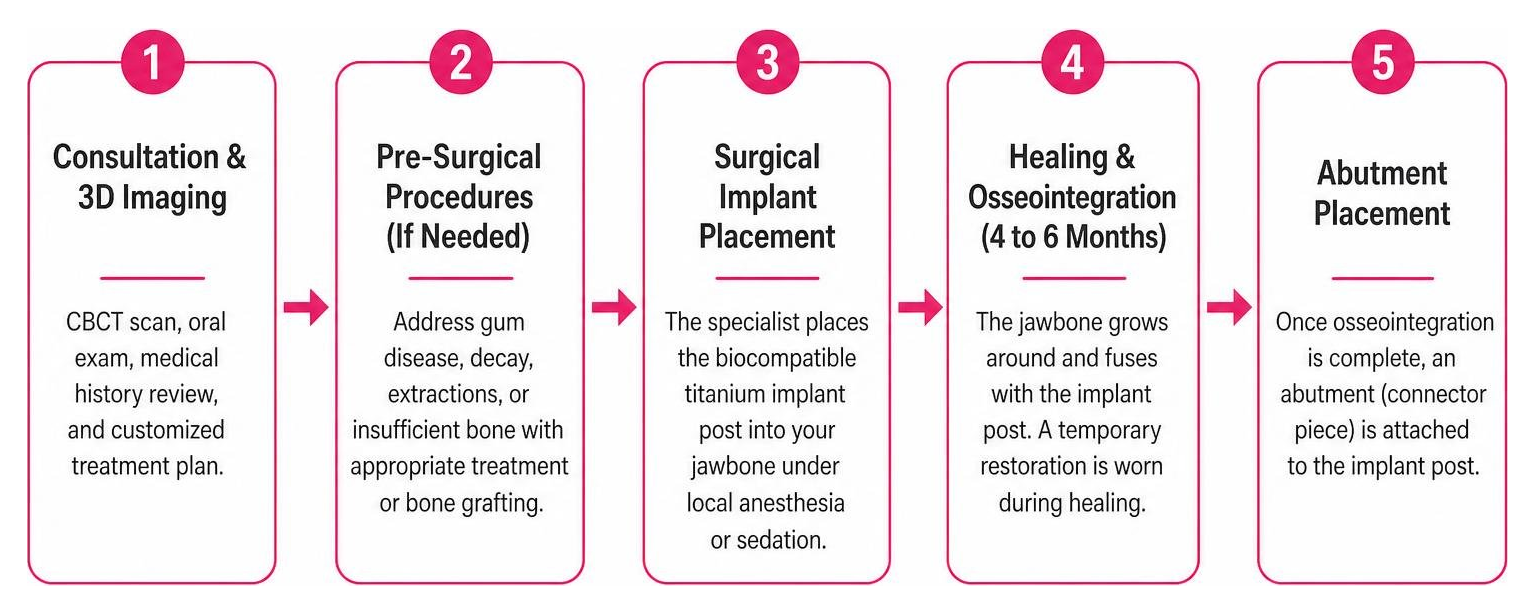
- Comprehensive Consultation & 3D Imaging: We take a CBCT scan, evaluate your oral health, discuss your medical history, and design a customized treatment plan.
- Pre-Surgical Procedures (If Needed): If you have active gum disease, decay, or insufficient bone, we will address these first with periodontal therapy, extractions, or bone grafting.
- Surgical Implant Placement: Under comfortable local anesthesia or sedation, the specialist places the biocompatible titanium post into your jawbone.
- Healing & Osseointegration (4 to 6 Months): Over the next several months, your jawbone naturally grows around and fuses with the implant post. You will wear a temporary restoration during this time so you never have to go without teeth.
- Abutment Placement: Once osseointegration is complete, a small connector piece called an abutment is attached to the implant post.
- Final Restoration: We take precise digital impressions to custom-craft your permanent crown, bridge, or overdenture, which is then securely attached to the abutment.
For a deeper look at what to expect financially throughout this process, please review our dental implants cost complete guide.
Comparing Tooth Replacement Options
To help you make an informed decision, let’s look at how dental implants compare to traditional bridges and removable dentures:
| Feature | Dental Implants | Traditional Dental Bridges | Removable Dentures |
|---|---|---|---|
| Lifespan | 30+ years to a lifetime | 5 to 15 years | 5 to 10 years (requires relines) |
| Bone Preservation | Excellent (stimulates bone growth) | None (bone continues to shrink) | None (accelerates bone loss) |
| Impact on Neighboring Teeth | None (preserves adjacent teeth) | High (requires shaving adjacent teeth) | Moderate (can wear down natural anchor teeth) |
| Chewing Capacity | 99% (feels like natural teeth) | 70% to 80% | 20% to 30% (prone to slipping) |
| Maintenance | Brush and floss normally | Requires special floss threaders | Must be removed and cleaned nightly |
| Aesthetic Appeal | Extremely natural | Natural | Can look bulky or unnatural |
Frequently Asked Questions about Dental Implants
How long do dental implants last and what maintenance is required?
With proper care and routine professional maintenance, dental implants are designed to last 30 years or even a lifetime! While the titanium post itself is immune to decay and will never need a root canal, the surrounding gum tissue is still vulnerable to infection.
Maintaining your implants is simple: brush twice a day, floss daily, and visit us regularly for professional cleanings and examinations. To read more about maximizing the lifespan of your new smile, check out our guide on how long do dental implants last.
Can I get dental implants if I have severe bone loss?
Absolutely! Even if you have been told by other providers that you lack the bone density required for implants, modern technology offers incredible solutions.
We can perform bone grafting or sinus lifts to rebuild your jawbone. For extreme cases of upper jaw bone loss, advanced specialists can utilize zygomatic or pterygoid implants. These specialized implants are longer than traditional posts and anchor directly into your dense cheekbone (zygoma) or the pterygoid plate, completely bypassing the need for extensive bone grafting.
How much do dental implants cost and does insurance cover them?
Because every smile is completely unique, the overall investment for dental implants varies based on the number of teeth being replaced, the need for preliminary bone grafting, and the type of final restoration you choose.
While dental implants generally require a higher upfront investment than dentures or bridges, their unmatched durability and ability to preserve your jawbone make them the most cost-effective long-term solution. Many dental insurance plans now offer partial coverage for implant procedures. To make your dream smile highly accessible, we also partner with trusted third-party financing companies to break your treatment cost down into affordable monthly payments.
Conclusion
At AZ Dentist, our clinical philosophy is built entirely around you. We understand that taking the first step toward tooth replacement can feel overwhelming, which is why we strive to create a warm, welcoming environment where you “come as a patient and leave as a friend.”
Whether you are looking to replace a single missing tooth or want to completely upgrade your quality of life with stable, implant-supported full-arch restorations, we are here to guide you every single step of the way.
Are you ready to achieve the healthy, radiant smile of a lifetime? We invite you to explore our comprehensive Sun City dental services complete guide or contact our friendly team at AZ Dentist Sedona, AZ Dentist Glendale, AZ Dentist Sun City, or AZ Dentist Scottsdale to schedule your personalized consultation today!