

Understanding the In Office Teeth Whitening Procedure
I’m Dr. Janne Lynch, and when you choose chairside bleaching, you are opting for a safe, controlled clinical environment where your oral health and comfort come first. Unlike store-bought strips or generic trays that can leak bleaching agents onto delicate gums, professional in-office care relies on careful preparation and direct supervision.
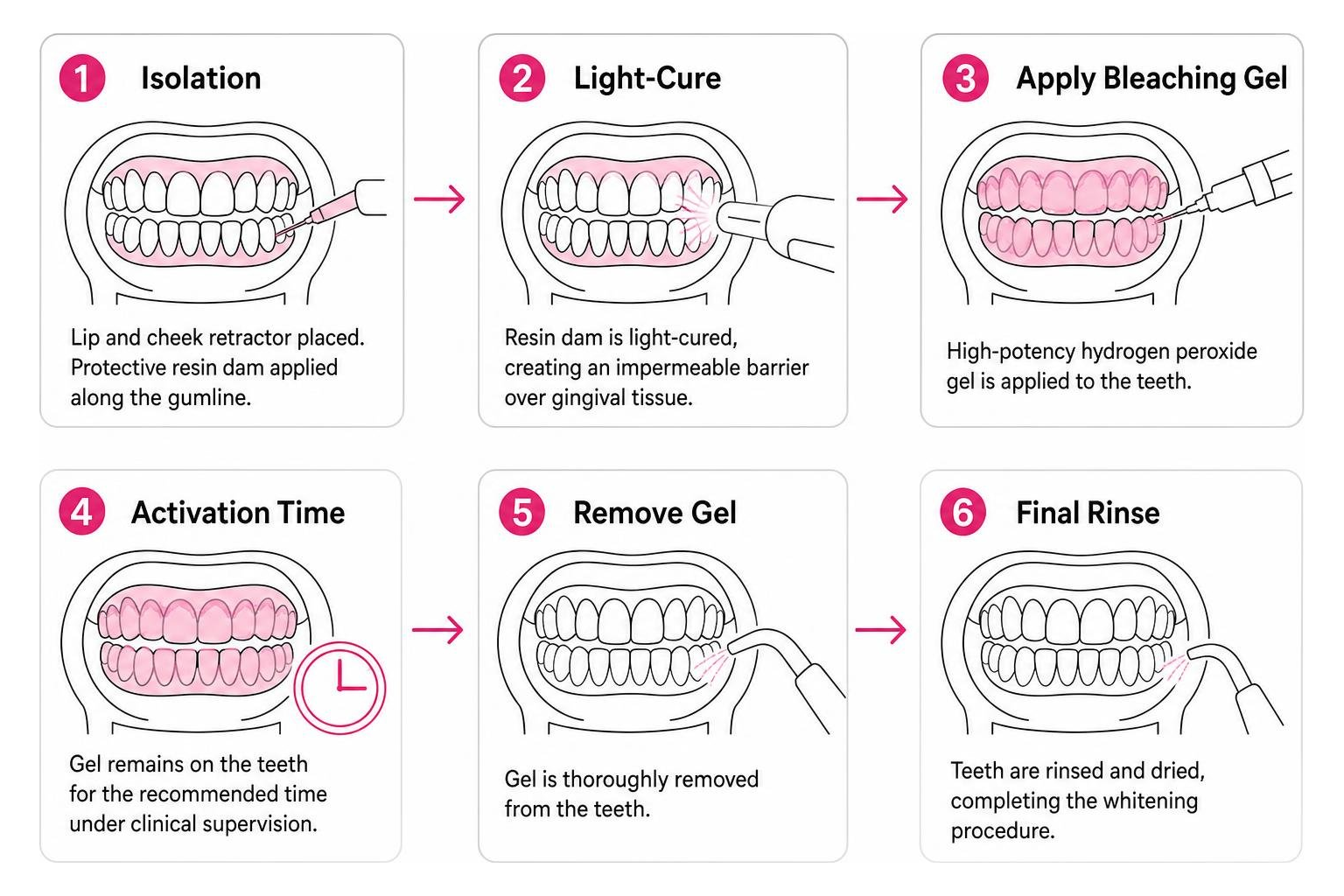
A standard appointment typically lasts between 60 and 90 minutes. Before any gel touches your teeth, we perform a thorough exam to verify that your enamel is intact and your gums are free of active inflammation. Once you are settled in the dental chair, we place a specialized lip and cheek retractor along with a protective resin dam along your gumline.
This liquid dam is light-cured, creating an impermeable barrier over your gingival tissue. Isolating the soft tissues ensures that the potent bleaching agent only contacts your enamel, preventing chemical burns or irritation. If you are comparing your aesthetic choices, exploring a broader cosmetic teeth whitening overview can help you see where chairside care fits into overall smile enhancement.
Chemical Mechanisms of In Office Teeth Whitening
The true magic behind professional whitening lies in the chemistry of oxidation. In-office systems utilize high-potency hydrogen peroxide gels ranging from 25% to 40% concentration.
When applied to the tooth surface, hydrogen peroxide rapidly breaks down into water, oxygen ions, and reactive oxygen molecules. These microscopic free radicals penetrate the porous crystalline structure of your enamel and underlying dentin. As they migrate inward, they target chromophores—the complex organic molecules with double chemical bonds responsible for holding yellow, brown, and gray stains. The reactive oxygen molecules oxidize and break these double bonds, altering how the stain molecules absorb light and leaving your teeth noticeably brighter.
Because clinical formulations are balanced with high water content (often 20% or more), they help maintain enamel hydration and protect tooth vitality during oxidation. Learning how clinicians whiten teeth safely without enamel damage can reassure you that supervised chemical bleaching does not erode or weaken healthy enamel structures.
Light and Laser Activation Technology
Depending on the system selected for your smile, your treatment may incorporate light acceleration. For example, systems like Philips Zoom In-Office Whitening | Philips utilize an advanced blue LED lamp emitting light at a targeted wavelength between 420 and 460 nm with an energy intensity of roughly 190 mW/cm².
Clinical studies show that pairing a 25% hydrogen peroxide gel with this specific blue light frequency can achieve up to 87% more stain removal in a 45-minute treatment window compared to peroxide gel alone. The light acts as a catalyst, exciting the peroxide molecules to accelerate the breakdown of deep extrinsic and intrinsic pigments.
Conversely, systems like Opalescence™ Pro-In-Office Teeth Whitening use chemically activated 40% hydrogen peroxide formulations that do not require any light source at all, relying purely on powerful chemical dynamics. Both approaches are backed by decades of research. You can explore the science of LED teeth whitening to understand how these photochemical reactions function chairside.
Professional Whitening Options and Restoration Considerations
Every smile is distinct, which means clinical whitening must be tailored to your starting shade, stain history, and existing dental work.
During candidate evaluation, we distinguish between extrinsic stains (caused by coffee, tea, wine, and tobacco) and intrinsic discoloration (stemming from aging, enamel trauma, fluorosis, or past tetracycline medication). While common dietary stains lift quickly, deeper intrinsic discoloration may require multiple applications or a combination approach that pairs an initial in-office session with customized take-home trays.
In Office Teeth Whitening Treatment Experience
During a standard treatment session, the whitening gel is applied in two to four separate cycles lasting 15 to 20 minutes each. Between cycles, we suction away the depleted gel and apply a fresh, active layer. This segmented application maximizes the concentration of active oxygen molecules working on your enamel throughout the appointment.
| Whitening Method | Active Ingredient Concentration | Treatment Time | Expected Lift | Supervision Level |
|---|---|---|---|---|
| In-Office Chairside | 25%–40% Hydrogen Peroxide | 60–90 Minutes (1 visit) | 3 to 8 Shades | Direct Dental Supervision |
| Take-Home Custom Trays | 10%–22% Carbamide Peroxide | 1–2 Weeks (daily use) | 2 to 6 Shades | Dentist-Monitored |
| Over-the-Counter Strips | 3%–10% Hydrogen Peroxide | 2–4 Weeks (daily use) | 1 to 3 Shades | Unsupervised |
For patients who prefer progressive results at home or who want ongoing touch-ups, kits such as the Zoom In-Office Whitening Kit WhiteSpeed 25% HP Kit with 14% DayWhite DIS557/01 | Philips , Zoom In-Office Whitening Kit In-office Kit with Touch-up DW 9.5% HP – 2pk DIS567/01 | Philips , or In-Office Whitening Kit In-office Kit with Touch-up DW 6% – 2pk DIS675/01 | Zoom offer professional maintenance options. Understanding the differences between teeth whitening methods ensures you choose the speed and delivery format that aligns with your lifestyle.
Restorations and Dental Material Compatibility
Bleaching agents only oxidize organic chromophores in natural tooth enamel and dentin. They do not alter the shade of non-porous restorative materials, including:
- Porcelain and ceramic crowns
- Porcelain veneers
- Composite resin bonding
- Tooth-colored fillings
If you have restorations on your visible front teeth, they will retain their original color while your natural enamel lightens around them. When planning a broader smile makeover, we whiten your natural teeth first to achieve your optimal brightness.
Additionally, residual oxygen from the whitening process temporarily reduces the adhesive bond strength of dental resins. For this reason, we always advise waiting 7 to 10 days after a whitening treatment before placing new composite bonding, veneers, or crowns. This allows the shade to stabilize and ensures optimal bonding strength.
Patient Safety, Sensitivity, and Longevity
Modern professional whitening formulas are engineered to minimize discomfort while maximizing shade lift.
Transient tooth sensitivity can happen when peroxide passes through the enamel to reach underlying dentinal tubules. To combat this, professional formulas incorporate soothing agents such as potassium nitrate (which calms pulpal nerve endings), fluoride, and amorphous calcium phosphate (ACP) to remineralize microscopic enamel pores.
Survey data indicates that 99% of patients treated with advanced systems like Zoom WhiteSpeed experience little to no sensitivity during their appointment, and 82% report zero sensitivity post-treatment. We also adjust light intensity settings or application dwell times to keep sensitive smiles completely comfortable.
Protocols for Pre-Treatment Preparation and Post-Care
Following strict pre- and post-treatment protocols protects your investment and ensures a radiant, long-lasting result:
- Schedule a professional cleaning: Complete a dental prophylaxis a few days before whitening to eliminate plaque and surface calculus, ensuring the gel contacts clean enamel evenly.
- Pre-treat for sensitivity: If you have naturally reactive teeth, brush with a potassium nitrate desensitizing toothpaste for 1 to 2 weeks leading up to your session.
- Follow the “White Diet” for 48 hours: For the first 24 to 48 hours post-treatment, microscopic enamel pores remain open and vulnerable to staining. Avoid chromogenic foods and drinks, including coffee, red wine, dark tea, soy sauce, tomato sauces, and berries.
- Avoid tobacco products: Nicotine and tobacco smoke will rapidly discolor newly whitened enamel.
- Maintain good oral hygiene: Brush twice daily with a non-abrasive fluoride toothpaste and floss daily to prevent new surface stains from accumulating.
Frequently Asked Questions About Professional Whitening
How many shades whiter can teeth get after a single session?
Most patients achieve an improvement of 3 to 8 shades in a single chairside visit. The total shade lift depends on your baseline enamel color, the origin of your discoloration, and your age. Furthermore, your teeth continue to undergo active oxidation for 24 to 48 hours after you leave the chair, frequently revealing an even brighter result over the following two days.
How long do professional chairside whitening results last?
In-office whitening results typically remain vibrant for 1 to 3 years. Longevity varies based on individual lifestyle choices and dietary habits. Routine consumption of staining beverages, smoking, and neglecting regular dental hygiene visits will shorten results. Utilizing custom take-home trays with gentle touch-up gels once every 4 to 6 months can help maintain your peak brightness indefinitely.
Does dental insurance cover in-office teeth bleaching?
Because teeth whitening is an elective cosmetic procedure aimed purely at improving aesthetics rather than restoring oral function or treating dental disease, standard dental insurance plans do not cover the cost. However, we provide flexible payment and financing options to help make your dream smile accessible and budget-friendly.
Conclusion
Professional in-office whitening offers an effective, scientifically proven way to lift years of staining in a single, comfortable appointment. Under direct dental supervision, you achieve dramatic, predictable shade lift while protecting your gums and enamel.
Whether you are preparing for a major milestone or refreshing your everyday look, our team provides compassionate care tailored to your unique smile goals. When you are ready for a brighter smile, schedule a consultation for professional teeth whitening at AZ Dentist Scottsdale, AZ Dentist Glendale, AZ Dentist Sun City, or AZ Dentist Sedona, and let us help you achieve a smile you will love sharing with the world.